
JOSÉ MARTÍ
September 28, 2026
PATRICE LUMUMBA
September 28, 2026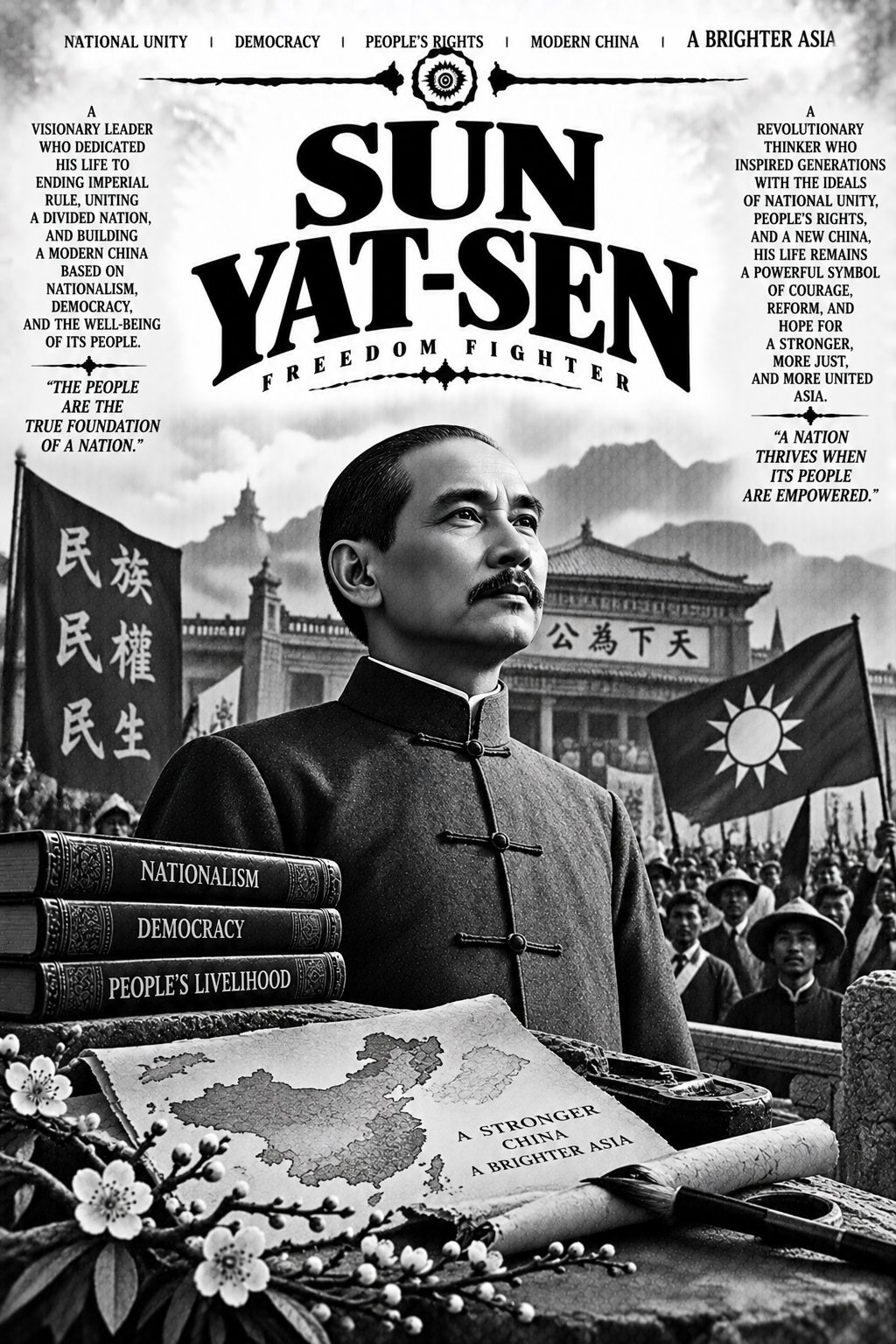
SUN YAT-SEN
Original price was: ₹500.00.₹199.00Current price is: ₹199.00.
He set out from a humble peasant village in the Pearl River Delta, laid aside the surgical scalpel of an elite medical career, and dared to confront the oldest continuous imperial monarchy on earth. Hunted across four continents by imperial assassins, locked inside a secret cell in the Chinese Legation in London awaiting execution, and barred from his own homeland for sixteen relentless years of exile, he stood immovable. From the shadows of foreign banishment arose the moral colossus and visionary architect of modern Asia—the legendary revolutionary universally revered as the **Father of Republican China**: **Dr. Sun Yat-sen**.
Refusing to accept four thousand years of dynastic servitude, Sun took on the decaying Qing Dynasty, not to crown himself a new emperor upon the Dragon Throne, but to deliver supreme sovereignty into the hands of the people. Mobilizing the global Chinese diaspora—from the humble laundrymen and miners of California to the tin-mine magnates of Southeast Asia—he united underground secret societies, mutinous soldiers, and idealistic students under an unyielding banner: the **Three Principles of the People** (*Sanmin Zhuyi*). Through ten blood-soaked failed uprisings, personal betrayals, and devastating loss, his resolve never fractured. When the historic guns of the Wuchang Uprising shattered the night of October 10, 1911, the imperial dam broke, sweeping away two millennia of imperial autocracy and birthing the first constitutional republic in Asian history.
Taking the oath as Provisional President in Nanjing on January 1, 1912, Sun demonstrated a standard of selfless statecraft rare in human history. To avert a ruinous civil war and seal the abdication of the last Manchu child-emperor, he voluntarily surrendered the supreme executive office, stepping down into private life to prove that a republic belongs to its citizens, not to an armed master. Even as his beloved nation fractured into the chaos of the Warlord Era, and as terminal cancer wracked his dying body, his final whispered summons to his people rang out as an immortal call to national dignity: *”The revolution is not yet finished; comrades, you must continue to strive!”*
This sweeping, fact-filled biography chronicles the breathless epic of an incorruptible pioneer who shattered the chains of divine-right monarchy, stood up to Western imperialism, and gave four hundred million people their sovereign soul. A searing testament to unbending patriotism, moral courage, and the sacred fire of human liberty, this is the definitive account of the visionary leader whose life proved that when an ancient civilization awakens to the light of freedom, no power on earth can extinguish its destiny.
Product Details
| Publication Date | September 28, 2026 |
| Last Updated | September 28, 2026 |
| Print Length | 190 pages |
| Language | English |
| Format | PDF eBook |
| Availability | Instant Download |
| Publisher | Vancriskhom Publishers |
| Compatible Devices | PC, Tablet, Mobile |
The Continental Transformer: An Anchor Beyond Ideological Divides
In the vast, turbulent panorama of twentieth-century political history, few figures match the transformative historical weight of Dr. Sun Yat-sen (Sun Wen). In modern global politics, where civil wars and ideological revolutions routinely fracture historical memory into bitter, irreconcilable camps, Sun stands in singular majesty across the Chinese-speaking world.
To the Republic of China (ROC) on Taiwan, he is venerated under the official state title of Guofu—the “Father of the Nation”—whose Five-Power constitutional architecture and Sanmin Zhuyi (Three Principles of the People) form the foundational articles of the constitution. Concurrently, to the People’s Republic of China (PRC) on the mainland, he is universally celebrated and formally honored as the immortal Geming Xianqu—the “Forerunner of the Democratic Revolution.” On every National Day in Beijing, his colossal portrait is erected in the physical center of Tiananmen Square, staring directly across the central axis toward the portrait of Mao Zedong on the ancient gate of the Forbidden City.
This universal reverence is not an accident of statecraft; it is the natural historical verdict earned by a man who fundamentally dismantled an imperial system that had endured for over two thousand years.
Before Sun Yat-sen launched his organizing efforts in the late nineteenth century, sovereign authority across the Chinese continent was understood exclusively through dynastic legitimacy:
The Emperor ruled as the celestial Son of Heaven (Tianzi), presiding over “All Under Heaven” (Tianxia) through an absolute, sacred Mandate (Tianming).
For two millennia—from the initial unification by Qin Shi Huang in 221 BC through the Han, Tang, Song, Yuan, and Ming dynasties—rebellions had erupted, dynasties had collapsed, and rivers of blood had been shed, but the historical imagination never transcended the dynastic cycle. One crowned emperor was overthrown merely to seat another dynastic master upon the Dragon Throne.
Sun Yat-sen broke that four-thousand-year cycle forever.
He did not fight to become a sovereign or seat a new ethnic Han dynasty in the palaces of Beijing. He fought to establish an entirely new philosophical universe in Asia: one where the imperial throne was discarded as a historical relic, where divine autocracy gave way to popular sovereignty, and where the Chinese people ceased to be imperial subjects (zimin) and became sovereign citizens (guomin) of a modern, constitutional Republic.
The Global Wanderer: Statecraft Forged in the Furnace of Exile
Remembering Sun Yat-sen requires understanding that his revolution was not born inside comfortable ministerial offices, military barracks, or ancient academies of classical learning. It was built across thirty years of exile, manual labor, physical hardship, and relentless global organizing.
Between his first flight from Guangzhou following the abortive uprising of October 1895 and his return to Shanghai as Provisional President in December 1911, Sun lived as an international fugitive:
The Qing imperial government placed bounties on his head that climbed to hundreds of thousands of silver dollars, sending consular spies and hired assassins to stalk him across multiple continents.
European colonial authorities in Asia, eager to preserve their lucrative trade concessions with Beijing, systematically expelled him: he was banished from British Hong Kong, expelled from Portuguese Macau, ordered out of French Indochina, and asked to leave Meiji Japan.
He lived out of worn leather suitcases, sleeping in third-class steamship cabins, immigrant boarding houses, and rural railway carriages across Honolulu, San Francisco, Chicago, New York, London, Paris, Brussels, Singapore, Penang, and Bangkok.
In October 1896, his life hung by a thread during the infamous London Kidnapping (Lundun Mengnan Ji). Trapped inside a barred third-floor room of the Qing Legation at No. 49 Portland Place in London, he faced immediate, secret rendition to China in a locked cargo crate to suffer public execution by the “death of a thousand cuts” (lingchi).
Saved only through the courage of an English servant and the relentless intervention of his former medical mentor, Dr. James Cantlie, Sun emerged from the ordeal not broken, but elevated onto the international stage as the recognized face of modern Chinese resistance.
Rather than surrendering to despair after ten consecutive armed uprisings collapsed in blood and defeat along the southern borderlands—from the early disaster of 1895 that claimed his beloved childhood friend Lu Haodong, to the heroic slaughter of the Seventy-Two Martyrs at Huanghuagang in April 1911—Sun persisted with an unyielding, almost prophetic resolve.
He was the great unifier who recognized the distinct strengths of a fractured diaspora:
The Modern Intelligentsia: He mobilized thousands of radical Chinese overseas students studying in Tokyo, Brussels, Paris, and Berlin, organizing them in August 1905 into the vanguard party: the Zhongguo Tongmenghui (Chinese United League).
The Ancient Underworld: He joined the Chee Kung Tong (the overseas lodge of the Tiandihui / Triads) in Honolulu, obtaining the senior military rank of “Red Staff” (Honggun), and systematically re-educated these ancient, insular Ming-loyalist secret societies into disciplined, republican funding instruments.
The Laboring Masses: He reached the laundrymen, miners, railway coolies, and small grocers of North America and Southeast Asia. He honored them as the “Mother of the Revolution” (Huaqiao wei geming zhi mu), collecting their hard-earned dollars, nickels, and dimes to buy repeating Mauser rifles, field artillery, and dynamite.
When the imperial dam finally shattered on the night of October 10, 1911, with the mutiny of the New Army at the Wuchang Uprising, it was the fruit of sixteen years of ideological, financial, and organizational preparation tended across the globe by Sun Yat-sen.
The Unprecedented Sacrifice: Power Relinquished for National Unity
In the history of world leadership, the measure of a revolutionary’s greatness is often found not in how fiercely they fight to seize power, but in how readily they surrender it for the welfare of their people.
On January 1, 1912, inside the illuminated presidential palace in Nanjing, Sun Yat-sen took the oath of office as the First Provisional President of the Republic of China:
He abolished the lunar dynastic calendar, inaugurated the solar calendar, and proclaimed the “First Year of the Republic” (Minguo Yuannian).
He adopted the Five-Color Flag (Wuse Qi), proclaiming the doctrine of “Five Races Under One Union” (Wuzu Gonghe) to preserve the territorial integrity of China as a multi-ethnic, egalitarian commonwealth uniting Han, Manchu, Mongol, Hui, and Tibetan peoples.
He issued decrees prohibiting the binding of female feet, outlawing judicial torture, eradicating hereditary degraded social castes, and establishing freedom of speech, assembly, and religious belief.
Yet, barely six weeks into his historic presidency, faced with the danger of a catastrophic civil war between the northern imperial Beiyang Army and the financially exhausted southern revolutionaries, Sun made a monumental personal sacrifice.
He sent a clear, direct offer to General Yuan Shikai, the military commander in Beijing: if Yuan would use his undisputed command of the northern divisions to force the permanent abdication of the Manchu court and declare his unreserved loyalty to the Republic, Sun would voluntarily resign the presidency and support Yuan as the first permanent head of state.
Yuan accepted the compact. On February 12, 1912, the six-year-old child-emperor Aisin-Gioro Puyi abdicated, closing the reign of the Great Qing and ending imperial dynastic rule.
The very next day, on February 13, 1912, Sun Yat-sen submitted his formal resignation to the Provisional Senate in Nanjing.
He laid down the supreme executive seals of a nation of four hundred million people without firing an unnecessary shot, stepping out of the presidential yamen as a private citizen.
His provisional presidency had lasted exactly ninety days.
While subsequent events proved tragic—Yuan Shikai quickly betrayed the constitutional order, assassinated the parliamentary architect Song Jiaoren in March 1913, dissolved the National Assembly, and attempted to crown himself emperor—Sun’s sacrifice established an irreversible moral precedent.
He proved to the world that republican office was not an imperial throne to be hoarded through blood, but a public trust held solely by the grace of the people.
When Yuan attempted to restore the empire in late 1915, and when warlord Zhang Xun attempted to restore the Qing throne in 1917, both efforts collapsed within weeks beneath a wall of nationwide public fury.
The Chinese people had experienced a republic under Sun Yat-sen; they refused to become subjects of an emperor ever again.
The Three Principles: A Sovereign Philosophy of Human Liberation
Sun Yat-sen’s enduring intellectual monument is the Three Principles of the People (Sanmin Zhuyi), an original, integrated political philosophy that synthesized the best elements of Western political economy with the ancient administrative traditions of China:
THE TRIPARTITE ARCHITECTURE OF SANMIN ZHUYI
Pillar of Thought Lincoln’s Ideal Core Structural Manifestation
─────────────────────────────────────────────────────────────────────────────
Minzu Zhuyi “Of the People” Anti-imperialism; multi-ethnic unity;
(Nationalism) recovery of full tariff & legal sovereignty.
Minquan Zhuyi “By the People” Five-Power Constitution; separation of political
(Democracy) power (popular rights) and administrative power.
Minsheng Zhuyi “For the People” Equalization of land rights; regulation of private
(Livelihood) capital; state-led infrastructure modernization.
Minzu Zhuyi (Nationalism): Evolving from its initial anti-Manchu roots, Sun transformed Minzu into a modern anti-imperialist doctrine. He diagnosed China as a “hypo-colony” (ci-zhimindi)—plundered by more than a dozen foreign powers under the Unequal Treaties without any imperialist master assuming responsibility for its welfare. Sun demanded the complete recovery of tariff autonomy, the abolition of foreign extraterritoriality, and the awakening of China from a “sheet of loose sand” into an organized, self-respecting nation capable of aiding the oppressed peoples of Asia and Africa.
Minquan Zhuyi (Democracy): Sun designed the Five-Power Constitution (Wu-Quan Xianfa), combining the Western tripartite separation of powers (Executive, Legislative, Judicial) with two classical, indigenous Chinese administrative branches: the Examination Yuan (an independent civil service testing organ to eliminate political patronage) and the Control Yuan (an independent ombudsman and censorate to investigate government corruption and impeach corrupt officials). Furthermore, he distinguished between sovereign political power (Quan—the people’s four direct rights of suffrage, recall, initiative, and referendum) and administrative governance power (Neng—the expert execution of state administration by qualified public servants).
Minsheng Zhuyi (People’s Livelihood): Rejecting laissez-faire capitalism that produced urban slums and predatory monopolies, while rejecting the Marxist doctrine of violent class warfare, Sun proposed an economic third way. Drawing upon Henry George, he formulated the Equalization of Land Rights (Pingjun Diquan), ensuring that future increases in land value created by community progress belonged to the public treasury, alongside the policy of “Land to the Tiller.” Through the Regulation of Capital (Jiezhi Ziben), he protected private initiative while mandating that essential natural monopolies and strategic heavy industries—railways, deep-water ports, steel mills, and mining—be operated by the state for the common good.
In his visionary 1920 economic treatise, The International Development of China (Shiye Jihua), Sun designed a master plan for the industrial transformation of China: proposing 100,000 miles of railways, 1,000,000 miles of paved highways, three modern deep-water ports, and the earliest conceptual engineering proposal for a massive hydroelectric dam across the Three Gorges of the Yangtze River—a blueprint that anticipated China’s colossal infrastructure achievements in the twenty-first century.
The Final Campaign and the Sacred Testament (1924–1925)
In the final years of his life, confronted by the chaos of the Warlord Era and the refusal of the Western democracies to support his constitutional government in Guangzhou, Sun executed a daring strategic realignment.
Assisted by Soviet Comintern advisers, Sun reorganized the Kuomintang at its First National Congress in January 1924, promulgating the Three Great Policies (San Da Zhengce): alliance with the Soviet Union, cooperation with the Chinese Communist Party in the First United Front, and assistance to the workers and peasants.
Realizing that thirty years of revolutionary setbacks were caused by the lack of an ideologically dedicated national army, Sun founded the Whampoa Military Academy (Huangpu Junxiao) in May 1924:
He appointed thirty-seven-year-old Chiang Kai-shek as Commandant.
He appointed the young communist intellectual Zhou Enlai as Director of the Political Department.
Whampoa trained the officers who would subsequently launch the historic Northern Expedition (Beifa), sweeping north to smash the warlord cliques and reunify the country under a single national flag.
In late 1924, despite suffering from the agonizing, debilitating symptoms of advanced liver cancer, the fifty-eight-year-old Sun undertook his final, heroic journey.
He accepted an invitation from northern leaders to travel to Beijing to convene a National People’s Assembly and negotiate the peaceful reunification of China, seeking to spare his people further civil conflict.
Stopping in Kobe, Japan, on November 28, 1924, Sun delivered his celebrated address on Greater Asianism (Da Ya-zhou Zhuyi).
He pleaded with Japan to abandon the imperialist “Way of Might” (Badao) and embrace the ancient Asian “Way of Right” (Wangdao), warning against the aggressive militarism that would subsequently engulf the Pacific in World War II.
Arriving in Beijing in December 1924, Sun collapsed and was admitted to the Peking Union Medical College Hospital.
On March 11, 1925, on his deathbed, surrounded by his devoted wife Soong Ching-ling, his son Sun Fo, and his closest comrades, Sun signed his immortal Political Testament (Zongli Yishu), leaving behind the words that became the sacred marching orders of modern Chinese history:
“For forty years I have dedicated myself to the cause of the national revolution with the sole objective of securing the freedom and equality of China.
The experience of these forty years has deeply convinced me that to achieve this aim, we must awaken the masses of our people, and unite in a common struggle with those nations of the world who treat us as equals.
The revolution is not yet finished!
All my comrades must strive in accordance with my works… and continue to exert their utmost efforts to bring about its realization.”
At 9:30 AM on the morning of March 12, 1925, Dr. Sun Yat-sen breathed his last.
His final whispered words were:
“Peace… Struggle… Save China!” (Heping, fendou, jiu Zhongguo!)
The Eternal Mausoleum on Purple Mountain
In June 1929, following the triumphant completion of the Northern Expedition and the formal reunification of China under the National Government, Sun Yat-sen’s body was transferred from Beijing to the southern capital of Nanjing.
There, on the forested southern slopes of Purple Mountain (Zijinshan)—near the ancient tombs of the Ming emperors—his remains were interred inside the monumental granite and blue-glazed tile Sun Yat-sen Mausoleum (Zhongshan Ling).
To reach his resting place, visitors must climb 392 stone steps, representing the estimated 392 million Chinese citizens living at the time of the 1911 Revolution.
At the summit of the mountain, carved into the blue stone pediments of the memorial hall, are the four classical characters that guided his entire life:
“Tian Xia Wei Gong”
(All Under Heaven Belongs to the Public)
Inside the chamber, engraved into the marble walls, is the complete text of the Three Principles of the People, standing alongside his life-sized seated marble statue.
The Living Beacon of a Nation’s Soul
Remembering Sun Yat-sen requires looking beyond the partisan divisions of twentieth-century politics to recognize the immortal core of his achievement:
He took an ancient, inward-looking, and exhausted empire of four hundred million people—traumatized by sixty years of foreign invasions, unequal treaties, and internal rebellions—and awakened within them the modern consciousness of national sovereignty and human dignity.
He demonstrated unmatched moral integrity: enduring sixteen years of exile, surviving imperial kidnappings and assassination squads, raising millions of dollars without pocketing a single dollar for himself, and walking away from the supreme presidency of the republic when he believed it would preserve peace for his country.
He forged an ideology that proved an ancient non-Western civilization could embrace modern democracy, rule of law, and industrial technology without surrendering its cultural identity or descending into the brutalities of unchecked capitalist exploitation.
Sun Yat-sen was the physician who diagnosed the mortal disease of an empire and applied the surgical knife of revolution to birth a republic.
He was the visionary wanderer whose faith in his people never wavered in the darkest hours of defeat.
His dying summons—”The revolution is not yet finished; comrades, you must continue to strive!”—remains an eternal national call to conscience.
In the modern avenues of Taipei, beneath the soaring towers of Shanghai, across the historic streets of Guangzhou, and within the hearts of tens of millions in the global diaspora, the spirit of Dr. Sun Yat-sen endures: the unconquerable pioneer, the incorruptible patriot, and the eternal Father of Republican China, whose life proved that when a nation awakens to the cause of liberty, its light can never be extinguished.
Only logged in customers who have purchased this product may leave a review.
General Enquiries
There are no enquiries yet.
Related products
-
The Day We Were Asked to Choose: Hearts That Built Horizon
Original price was: ₹700.00.₹199.00Current price is: ₹199.00. EAN: 2000000000756

Reviews
There are no reviews yet.