
SUN YAT-SEN
September 28, 2026
JOMO KENYATTA
September 28, 2026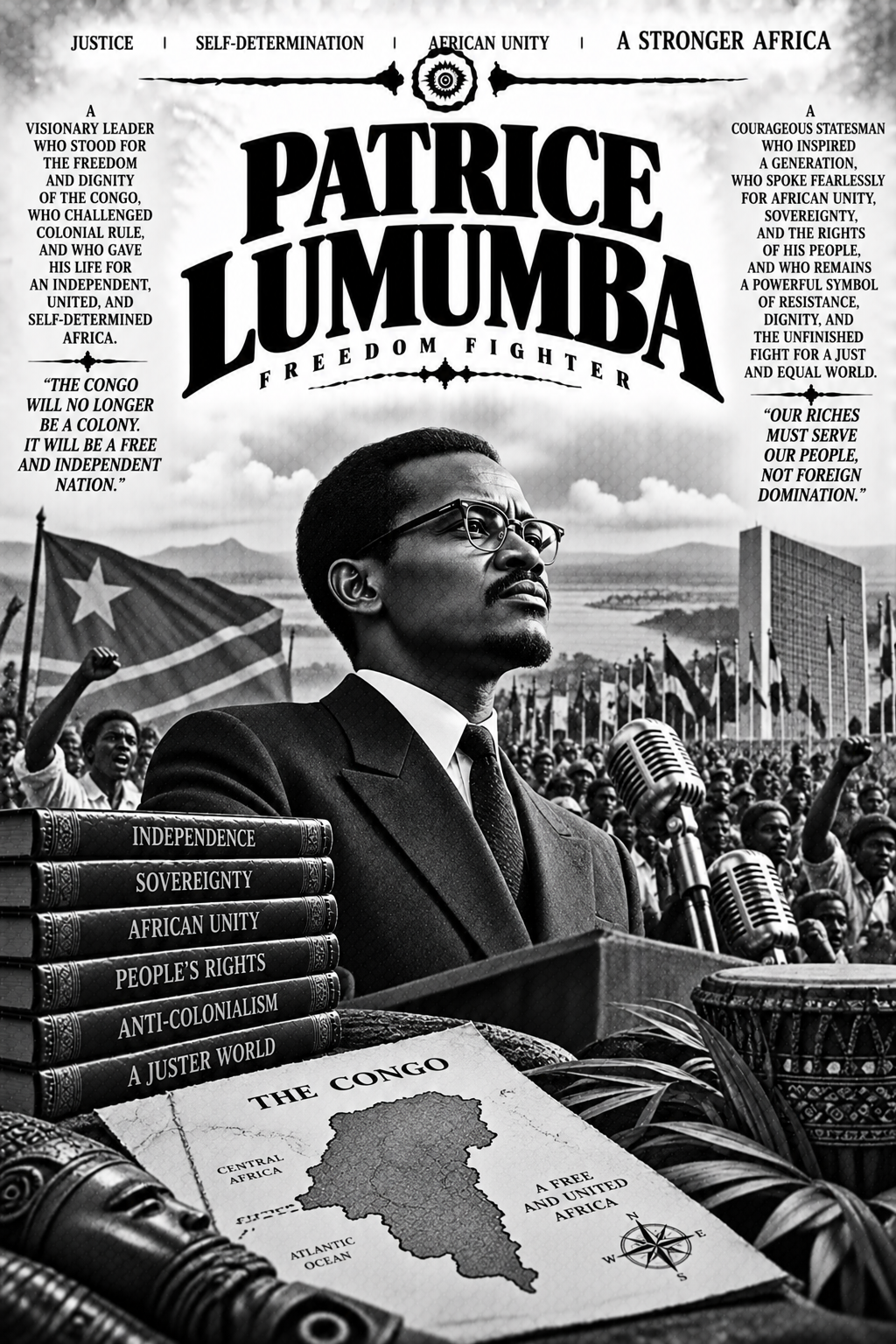
PATRICE LUMUMBA
Original price was: ₹500.00.₹199.00Current price is: ₹199.00.
The Indestructible Icon of the African Century
In the tumultuous history of decolonization, no single life concentrates the incandescent promise and the devastating tragedy of African liberation more intensely than that of Patrice Émery Lumumba. He held executive power for seventy-five days. He was thirty-four years old when democratically invested as the first Prime Minister of the Republic of the Congo, and barely thirty-five when an execution squad supervised by Belgian officers shot him in a secluded clearing in the Katangese savanna.
Yet, across the span of modern history, few statesmen have left an imprint so deep, enduring, and globally transformative.
The assassins who dragged him to Mwadingusha on the night of January 17, 1961, and the intelligence operatives who submerged his dismembered remains in drums of sulfuric acid, operated under an imperial delusion: they believed that by obliterating his physical body and scattering his ashes to the winds, they could erase the idea he embodied. They failed to grasp a fundamental law of political liberation: an army can execute a head of state, but it cannot execute an awakened national consciousness.
Lumumba was not merely an individual leader; he was the living embodiment of an epochal dream. That dream was the reclamation of full, unconditional African sovereignty—a vision that refused to accept nominal political independence as a substitute for economic liberation, racial dignity, and genuine continental self-determination.
Remembering Patrice Lumumba requires stripping away the Cold War slanders that sought to bury him a second time. He was neither a communist agent nor an erratic demagogue. He was an African nationalist of rigorous intellectual clarity, an uncompromising champion of the unitary state, and a prophet of non-alignment who recognized that a balkanized, mineral-rich Congo would remain an eternal playground for multinational concessionaires and foreign powers.
Though his physical tenure was cut down, his ideas broke free from the savanna of Katanga to become the sacred, unyielding standard against which every struggle for African sovereignty is measured.
The Architecture of the Vision: The Three Pillars of Lumumbism
Following his martyrdom, the political philosophy and praxis developed by Lumumba across his years in the postal union, the évolué cultural salons, the Mouvement National Congolais (MNC), and his brief premiership crystallized into what political theorists across the Global South celebrate as Lumumbism.
This doctrine rested upon three fundamental, interdependent pillars:
THE ARCHITECTURE OF LUMUMBISM
Foundational Pillar Core Political Directive Structural Objective
─────────────────────────────────────────────────────────────────────────────
The Unitary State Total eradication of tribalism Preserve 2.3 million sq km of
(L’État Unitaire) and ethno-regional federalism. Congolese soil as an indivisible state.
Economic Sovereignty Reclaim subsoil wealth from Break the monopoly of UMHK, Forminière,
(Souveraineté Écon.) foreign concession trusts. and use copper/cobalt for the people.
Pan-African Non-Align Continental anti-imperialist Reject Cold War vassalage; unite Africa
(Panafricanisme) solidarity and neutralism. against neo-colonial balkanization.
1. The Unitary State and the War on Tribalism
Lumumba recognized with absolute precision that ethnic regionalism (le tribalisme) was an imperial weapon. Under the policy of divide-and-rule, the Belgian administration had spent decades encouraging ethnic chauvinism to prevent the emergence of a cross-provincial class consciousness.
While political rivals like Joseph Kasa-Vubu (ABAKO) sought to reconstruct an ethnic Kongo sanctuary in the west, and Moïse Tshombe (CONAKAT) allied with European white settlers to guard Katangese mining revenues against internal migrants, Lumumba insisted that the Congo must be one, indivisible democratic commonwealth.
He understood that if the territorial integrity of the Congo fractured, the nation would disintegrate into fragile, tribal client states dominated by foreign capital. His insistence on the unitary state was not an authoritarian desire for centralization, but the sole structural defense against imperial re-colonization.
2. Complete Economic Reclamation
To Lumumba, political independence was meaningless if the mineral wealth of the soil remained in the hands of European holding companies. In 1960, the concessionaire giant Union Minière du Haut-Katanga (UMHK) generated sixty percent of the national revenue, operated its own private rail lines and police forces, and transferred billions of francs in dividends to foreign shareholders while ninety-five percent of the Congolese population lived in rural poverty.
Lumumba demanded that the Congolese state own and control its natural resources: its copper, cobalt, industrial diamonds, timber, and the strategic uranium deposits of Shinkolobwe. He proclaimed that the mineral riches gifted by nature to the heart of Africa must serve to build hospitals, universities, irrigation works, and transport systems for African children, rather than financing corporate dividends in Brussels, London, and New York.
3. Sovereign Pan-Africanism and Non-Alignment
Forged during his meetings with Kwame Nkrumah, Frantz Fanon, and Sékou Touré at the All-African Peoples’ Conference in Accra in 1958, Lumumba’s international vision was deeply pan-African. He refused to allow the newly liberated Congo to be drawn into the binary ideological trench warfare of the Cold War.
He declared that the Congo was neither pro-Western nor pro-Soviet, but pro-African: practicing positive neutralism. He saw the giant Congo as the geographic and economic pivot of Africa: if the Congo remained free, its strategic position and vast resources could serve as an unsinkable base for the armed liberation of the remaining white-minority regimes across Southern Africa—Angola, Mozambique, Rhodesia, and apartheid South Africa.
The Global Reverberations: A Catalyst for Worldwide Awakening
The assassination of Patrice Lumumba in January 1961 was an international watershed. Rather than stabilizing the Western grip on Central Africa, the revelation of his murder sent shockwaves of political radicalization throughout the world, permanently transforming the international anti-colonial movement.
1. The Radicalization of Continental Liberation
Across Africa, the realization that Western powers had orchestrated the liquidation of a democratically elected Prime Minister shattered any lingering illusions that European empires would surrender power gracefully:
In Algeria, the Front de Libération Nationale (FLN) hardened its armed posture, citing the tragedy of the Congo as definitive proof that imperialism could be defeated only through armed struggle.
The legendary anticolonial theorist Frantz Fanon, writing in the shadow of Lumumba’s death in his 1961 masterpiece The Wretched of the Earth (Les Damnés de la Terre), dedicated an entire chapter to the tragedy. Fanon famously proclaimed:
“Africa has the shape of a revolver, and the Congo is its trigger. If the trigger jams, the entire continent remains paralyzed; if the trigger breaks, the entire continent explodes.”
Liberation vanguards in Portuguese Africa—the MPLA in Angola led by Agostinho Neto, FRELIMO in Mozambique led by Eduardo Mondlane, and the PAIGC in Guinea-Bissau led by Amílcar Cabral—drew upon the murder of Lumumba to abandon peaceful negotiation in favor of protracted guerrilla warfare.
2. Che Guevara and the African Front (1965)
In late 1964 and 1965, the Argentine revolutionary Ernesto “Che” Guevara traveled to Africa to honor what he viewed as the supreme unfulfilled duty of the global revolution: avenging and completing the work of Patrice Lumumba.
Addressing the United Nations General Assembly in New York on December 11, 1964, Guevara pointedly condemned the Western powers and the United Nations for their complicity in Lumumba’s assassination:
“The free men of the world must prepare to avenge the crime of the Congo… All of us know how the tragic drama of the Congo and of its martyr, Patrice Lumumba, was played out. How is it possible that we can forget that the state of Katanga was created by Belgian paratroopers and mining syndicates?”
Months later, in April 1965, Che Guevara secretly crossed Lake Tanganyika into the eastern mountains of the Congo, leading a detachment of Afro-Cuban guerrilla fighters to assist the pro-Lumumbist Simba Rebellion headed by Laurent-Désiré Kabila and Gaston Soumialot.
Though the military expedition foundered amidst tactical divisions, Guevara’s presence confirmed Lumumba’s status as a universal symbol of international solidarity.
3. The Black Consciousness Movement and Malcolm X
In the United States, Lumumba’s life and death galvanized the Civil Rights movement and directly fueled the emergence of the Black Power and Black Consciousness movements:
In February 1961, African American activists and writers—including Maya Angelou, Amiri Baraka, and Rosa Guy—stormed the United Nations Security Council gallery in New York, disrupting sessions to denounce the murder of Lumumba.
Malcolm X emerged as one of the most ardent champions of Lumumba in the West. He repeatedly invoked Lumumba’s name in speeches across Harlem and university campuses, identifying Lumumba as the greatest Black statesman produced by twentieth-century Africa. In a historic speech in 1964, Malcolm X declared:
“Patrice Lumumba was the greatest Black man who ever walked the African continent. He didn’t fear anybody. He had those people so scared they had to kill him. They couldn’t buy him, they couldn’t intimidate him, and they couldn’t bend him.”
4. The Global Intellectual Legacy
Across the socialist and non-aligned worlds, Lumumba’s name was consecrated into the architecture of international solidarity:
In Moscow, the Soviet government founded the Patrice Lumumba Peoples’ Friendship University in 1961, an institution dedicated to educating tens of thousands of young students, engineers, and doctors from across Africa, Asia, and Latin America.
Streets, public squares, schools, and hospitals were named in his honor from Cairo to Havana, from New Delhi to Bamako, ensuring that his name became synonymous with the unconquerable spirit of Third World liberation.
The Domestic Struggle: From Mobutu’s Cynicism to the Second Liberation
Inside the borders of the Congo, the decades following Lumumba’s assassination bore witness to the grim fulfillment of his worst warnings:
General Joseph-Désiré Mobutu, the man who had seized power with CIA backing and delivered Lumumba to his executioners, established one of the most corrupt, brutal, and prolonged kleptocracies in modern history.
For thirty-two years (1965–1997), Mobutu ruled the rebranded nation of Zaire as a Western Cold War garrison state: plundering billions of dollars in state revenues, transferring public funds into private Swiss bank accounts, and allowing foreign mining syndicates unrestricted access to the nation’s wealth while the domestic infrastructure collapsed into ruins.
Yet such was the enduring power of Lumumba’s memory among the Congolese masses that even Mobutu could not suppress it.
In a display of political cynicism, Mobutu realized in the late 1960s that his regime lacked moral legitimacy.
On June 30, 1966—the sixth anniversary of independence—Mobutu stood before the public and officially proclaimed Patrice Lumumba a National Hero (Héros National), dedicating a colossal monument to him at the entrance of Kinshasa on the Limete interchange.
Mobutu sought to domesticate the martyr: turning the fiery anti-imperialist revolutionary into a harmless, plastic national icon while maintaining the very system of foreign corporate plunder and authoritarian repression Lumumba had died fighting against.
The masses were not deceived.
Throughout the decades of Mobutist dictatorship, the real spirit of Lumumba was kept alive underground:
In the forests of Kwilu, Pierre Mulele launched the Mulelist Insurrection of 1964 under the banner of completing the Lumumbist revolution, mobilizing peasant masses with the slogan: “The struggle continues until the final victory of the people.”
In the eastern mountains of Fizi and Baraka, Laurent-Désiré Kabila maintained a decades-long armed resistance within the Maquis, preserving the flame of the MNC-Lumumba.
When the Alliance of Democratic Forces for the Liberation of Congo-Zaire (AFDL) swept across the country in May 1997 to topple the dying Mobutu regime, they marched to the songs of the Lumumbist revolution.
The Prophecy Fulfilled: “Africa Will Write Its Own History”
In the final days of his imprisonment at Camp Hardy in Thysville, knowing that his execution was imminent, Lumumba wrote his immortal farewell letter to his wife, Pauline Opango.
The concluding paragraph of that letter is a monumental prophecy in the history of human freedom:
“The day will come when history will speak. But it will not be the history which will be taught in Brussels, Paris, Washington, or the United Nations…
Africa will write its own history, and it will be, to the north and to the south of the Sahara, a history of glory and dignity.”
That prophecy has steadily, relentlessly come to pass.
The official colonial narrative—which for decades depicted the Belgian presence as a benevolent “civilizing mission” and dismissed Lumumba as a chaotic, unhinged agitator who brought ruin upon his country—has collapsed beneath the weight of historical truth:
The investigative revelations of historians, sociologists, and journalists, led by Ludo De Witte’s groundbreaking 1999 documentation, exposed the direct complicity of the Belgian Crown, the Belgian military, and the American CIA in the murder.
In 2002, the Kingdom of Belgium was forced onto its knees, officially delivering a solemn, historic apology to the Congolese people and to the Lumumba family for its role in the crime.
The United States Senate Church Committee investigations formally unmasked the CIA’s covert plots, confirming the involvement of the highest levels of the American executive branch in seeking Lumumba’s assassination.
The ultimate, poetic victory over the executioners occurred in the summer of 2022.
For over six decades, the men who dissolved his body in sulfuric acid believed they had denied him a resting place.
Yet on June 20, 2022, inside the Egmont Palace in Brussels, the Belgian government officially returned the sole surviving physical trace of the Prime Minister—his gold-crowned tooth, recovered from the family of police commissioner Gérard Soete—to his surviving children, headed by his daughter Juliana Lumumba.
The relic of the martyr was flown home to the Democratic Republic of the Congo.
For ten days, the casket was carried in triumph across the lands he had loved and defended:
It was greeted with tears, tribal dances, and ancestral ceremonies in his birth village of Onalua in Sankuru.
It was met by hundreds of thousands of shouting, weeping citizens in his political citadel of Kisangani (Stanleyville).
It was brought to the blood-stained soil of Lubumbashi (Élisabethville) in Katanga, where his blood had consecrated the savanna earth.
On June 30, 2022—sixty-two years to the day after he stood before King Baudouin and delivered the unvarnished truth of colonial brutality—Patrice Lumumba was permanently interred inside a monumental concrete and glass mausoleum at the Place de l’Échangeur in Kinshasa.
The tooth of the founder was laid to rest beneath the soaring national monument, draped in the blue, red, and yellow flag of the sovereign Republic.
The Unconquerable Flame
Remembering Patrice Lumumba requires that we look upon him not as a tragic victim frozen in the past, but as an active, living force driving the contemporary global struggle for justice.
He remains the moral compass of the African continent:
In an era where multinational corporations continue to plunder the rich coltan, cobalt, and lithium deposits of the eastern Congo to power the green and digital technologies of the Western and Asian economies, while leaving the local population in poverty and war, the voice of Lumumba resounds as an urgent call to action.
In an era where African youth across the Sahel, the Great Lakes, and the Atlantic coast are demanding a “Second Independence”—rising against monetary neocolonialism, foreign military bases, and corrupt puppet regimes—it is the portrait, the words, and the unbending stance of Patrice Lumumba that flutter upon their banners.
Patrice Lumumba lived with an intensity that burned through the structures of empire. He refused to compromise, refused to flatter the powerful, and refused to sell the sovereign birthright of his people for personal wealth or physical survival.
He rode the storm of history with his head unbowed and his faith in human dignity intact.
The executioners of Mwadingusha have dissolved into the dust of historical infamy; the empire of Leopold has vanished into museum archives; but the voice of the thirty-five-year-old Prime Minister remains immortal, ringing out across the vast forests, the winding rivers, and the soaring cities of an awakened Africa:
**”Neither brutality, nor cruelty, nor torture will ever bring me to ask for mercy, for I prefer to die with my head high, my faith unshakeable, and my confidence profound in the destiny of my country, rather than to live in submission and the surrender of sacred principles.
Long live the independent and sovereign Congo! Long live the liberated, united Africa!”**
Patrice Lumumba died facing the sun; and his dream, outliving the battlefield and the grave, remains the eternal, shining beacon that will guide the liberation of the African continent forever.
Product Details
| Publication Date | September 28, 2026 |
| Last Updated | September 28, 2026 |
| Print Length | 166 pages |
| Language | English |
| Format | PDF eBook |
| Availability | Instant Download |
| Publisher | Vancriskhom Publishers |
| Compatible Devices | PC, Tablet, Mobile |
He emerged from the equatorial forests of Kasai, rose from the sorting desks of an inland colonial post office, and dared to shatter the eighty-year silence of an empire. When the monarchs and ministers of Europe gathered in Léopoldville on June 30, 1960, expecting a docile celebration of paternalistic benevolence, he seized the microphone and delivered an unsparing indictment of forced labor, racial humiliation, and colonial violence that reverberated across the globe. He was thirty-four years old, the first democratically elected Prime Minister of the Republic of the Congo, and the incandescent voice of an awakened continent: **Patrice Émery Lumumba**.
Refusing to allow his newly liberated nation to be reduced to a fractured playground for multinational mining monopolies and Cold War superpowers, Lumumba stood immovable. He championed an indivisible, sovereign republic where the immense wealth of the soil—its copper, cobalt, and uranium—belonged not to foreign corporate boards, but to the children of Africa. When imperialist gunboats attacked, corporate-financed provincial rebellions severed the nation’s mineral lungs, and foreign intelligence agencies mobilized to destroy him, Lumumba chose principle over survival. Betrayed by domestic traitors and abandoned by the international community, he faced the gun barrels of an imperial-backed firing squad in the savanna of Katanga without flinching, without trembling, and without begging for mercy.
Though his executioners dissolved his body in vats of acid to erase him from the face of the earth, they could not assassinate an immortal idea. His final, prophetic words from his prison cell rang true across the generations: *”Africa will write its own history, and it will be a history of glory and dignity.”*
This sweeping, fact-filled biography captures the breathtaking rise, the uncompromising statecraft, and the heroic martyrdom of Africa’s greatest revolutionary titan. A searing chronicle of moral courage, unyielding patriotism, and the sacred struggle for genuine human self-determination, this is the definitive account of the leader whose life became the eternal flame of African sovereignty—an unconquerable spirit that outlived the grave to illuminate the path of continental freedom forever.
Only logged in customers who have purchased this product may leave a review.
General Enquiries
There are no enquiries yet.
Related products
-
Mannar House: The Memory He Left Behind book 14
Original price was: ₹250.00.₹129.00Current price is: ₹129.00. EAN: 2000000001593

Reviews
There are no reviews yet.