

K. KUNHIRAMAN NAMBIAR
September 15, 2026
GOPABANDHU CHOUDHURY
September 15, 2026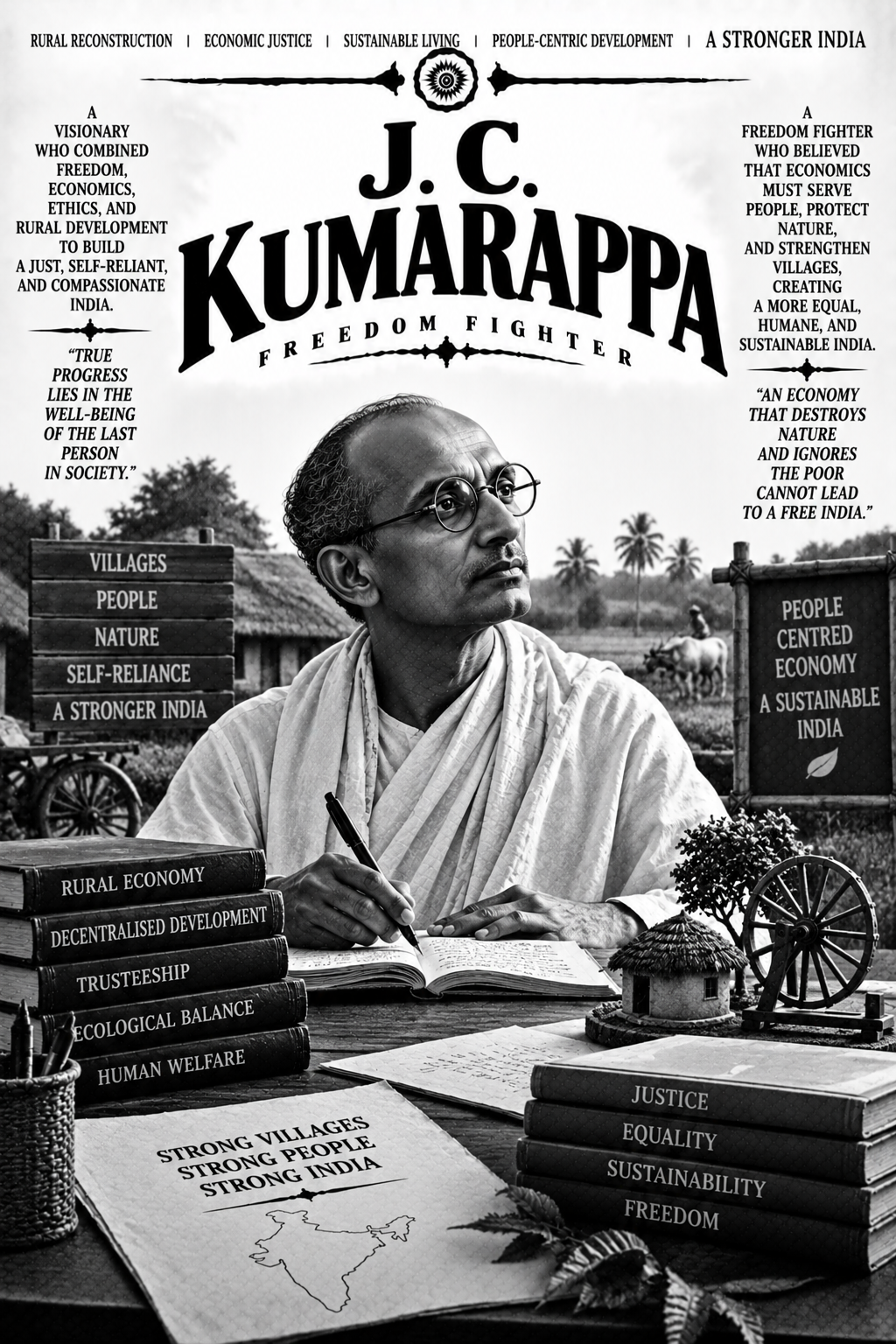
J. C. KUMARAPPA
Original price was: ₹199.00.₹9.00Current price is: ₹9.00.
Before India could break the chains of British political dominion, it had to shatter an even more insidious tyranny: the economic machinery of an empire that drained the lifeblood of seven hundred thousand villages to fuel foreign factories and line imperial coffers. The British Raj defended its rule behind the sophisticated ledger sheets of modern finance, asserting that colonial administration brought order, progress, and sound economics to the subcontinent.
To tear down that imperial lie required an intellect forged in the very financial citadels of the West—a master of capital who could audit the British Empire into ideological bankruptcy.
**J. C. Kumarappa: The Auditor of Empire and the Architect of Village Freedom** reveals the extraordinary, forgotten saga of Joseph Chelladurai Cornelius, an elite, Western-educated accountant who sacrificed fortune, health, and comfort to become the intellectual powerhouse of the Gandhian movement.
Trained in the financial heart of the City of London and holding advanced credentials from Columbia University under the legendary fiscal theorist Edwin R. A. Seligman, Kumarappa commanded immense wealth as a corporate auditor in Bombay. He wore bespoke three-piece suits, moved in high colonial society, and audited multinational commercial empires. But beneath the numbers, he saw the horrifying reality of imperial policy: an inverted tax system that extracted grain and salt taxes from starving peasants to finance British wars abroad, while starving India of education, health, and infrastructure.
In May 1929, an electrifying meeting with Mahatma Gandhi at the Sabarmati Ashram changed the course of India’s economic history. Challenged by the Mahatma to diagnose the disease and build the cure, Kumarappa made an absolute break with his past. He surrendered his corporate partnership, packed away his Savile Row suits for coarse, hand-spun white Khadi, reclaimed his indigenous ancestral name, and moved into an austere mud-and-thatch hut to dedicate his life to the rural poor.
From that moment, Kumarappa’s accounting pen became a lethal weapon of national liberation. Commissioned by the Indian National Congress at the historic 1931 Karachi Session, he conducted an audit of the colonial public debt, proving that over 7,200 million rupees of imperial liabilities were fraudulent obligations forced onto the Indian people. He took the helm of *Young India* during the Salt Satyagraha, organized the All India Village Industries Association (AIVIA) to invent low-cost, decentralized rural technologies, and faced the lathis, solitary confinement, and penal labor of British prisons in Sabarmati, Nasik, and Jabalpur.
Locked behind prison walls during the Quit India movement, Kumarappa drafted his masterwork, *The Economy of Permanence*, anticipating modern ecological economics decades before the rest of the world. He warned that true freedom (*Purna Swaraj*) could never be achieved by simply replacing white colonial bureaucrats with brown industrial elites to build centralized urban factories. Real freedom had to live where India lived—in self-reliant, decentralized, and ecologically sustainable village republics.
When independence finally arrived, Kumarappa stood as an incorruptible sentinel. He championed the radical doctrine of “Land to the Tiller” in his landmark 1949 Agrarian Reforms Report, courageously challenged the heavy-industry dogmas of the post-colonial state, and refused government titles or political sinecures, choosing instead to live out his final days in a mud-walled ashram in Tamil Nadu among the working people he loved.
Lyrical, impeccably researched, and surging with patriotic reverence, this book resurrects J. C. Kumarappa as one of the towering moral and intellectual giants of modern India. It is the unforgettable epic of the chartered accountant who walked away from an empire of greed to build an enduring sanctuary of human dignity, village self-reliance, and sovereign freedom.
Product Details
| Publication Date | September 15, 2026 |
| Last Updated | September 16, 2026 |
| Print Length | 112 pages |
| Language | English |
| Format | PDF eBook |
| Availability | Instant Download |
| Publisher | Vancriskhom Publishers |
| Compatible Devices | PC, Tablet, Mobile |
Before India could break the chains of British political dominion, it had to shatter an even more insidious tyranny: the economic machinery of an empire that drained the lifeblood of seven hundred thousand villages to fuel foreign factories and line imperial coffers. The British Raj defended its rule behind the sophisticated ledger sheets of modern finance, asserting that colonial administration brought order, progress, and sound economics to the subcontinent.
To tear down that imperial lie required an intellect forged in the very financial citadels of the West—a master of capital who could audit the British Empire into ideological bankruptcy.
**J. C. Kumarappa: The Auditor of Empire and the Architect of Village Freedom** reveals the extraordinary, forgotten saga of Joseph Chelladurai Cornelius, an elite, Western-educated accountant who sacrificed fortune, health, and comfort to become the intellectual powerhouse of the Gandhian movement.
Trained in the financial heart of the City of London and holding advanced credentials from Columbia University under the legendary fiscal theorist Edwin R. A. Seligman, Kumarappa commanded immense wealth as a corporate auditor in Bombay. He wore bespoke three-piece suits, moved in high colonial society, and audited multinational commercial empires. But beneath the numbers, he saw the horrifying reality of imperial policy: an inverted tax system that extracted grain and salt taxes from starving peasants to finance British wars abroad, while starving India of education, health, and infrastructure.
In May 1929, an electrifying meeting with Mahatma Gandhi at the Sabarmati Ashram changed the course of India’s economic history. Challenged by the Mahatma to diagnose the disease and build the cure, Kumarappa made an absolute break with his past. He surrendered his corporate partnership, packed away his Savile Row suits for coarse, hand-spun white Khadi, reclaimed his indigenous ancestral name, and moved into an austere mud-and-thatch hut to dedicate his life to the rural poor.
From that moment, Kumarappa’s accounting pen became a lethal weapon of national liberation. Commissioned by the Indian National Congress at the historic 1931 Karachi Session, he conducted an audit of the colonial public debt, proving that over 7,200 million rupees of imperial liabilities were fraudulent obligations forced onto the Indian people. He took the helm of *Young India* during the Salt Satyagraha, organized the All India Village Industries Association (AIVIA) to invent low-cost, decentralized rural technologies, and faced the lathis, solitary confinement, and penal labor of British prisons in Sabarmati, Nasik, and Jabalpur.
Locked behind prison walls during the Quit India movement, Kumarappa drafted his masterwork, *The Economy of Permanence*, anticipating modern ecological economics decades before the rest of the world. He warned that true freedom (*Purna Swaraj*) could never be achieved by simply replacing white colonial bureaucrats with brown industrial elites to build centralized urban factories. Real freedom had to live where India lived—in self-reliant, decentralized, and ecologically sustainable village republics.
When independence finally arrived, Kumarappa stood as an incorruptible sentinel. He championed the radical doctrine of “Land to the Tiller” in his landmark 1949 Agrarian Reforms Report, courageously challenged the heavy-industry dogmas of the post-colonial state, and refused government titles or political sinecures, choosing instead to live out his final days in a mud-walled ashram in Tamil Nadu among the working people he loved.
Lyrical, impeccably researched, and surging with patriotic reverence, this book resurrects J. C. Kumarappa as one of the towering moral and intellectual giants of modern India. It is the unforgettable epic of the chartered accountant who walked away from an empire of greed to build an enduring sanctuary of human dignity, village self-reliance, and sovereign freedom.
Only logged in customers who have purchased this product may leave a review.
General Enquiries
There are no enquiries yet.
Related products
-
Why Should a Women Be Respected?
Original price was: ₹500.00.₹149.00Current price is: ₹149.00. EAN: 2000000000954

Reviews
There are no reviews yet.