
INDULAL YAGNIK
September 16, 2026
ABBAS TYABJI
September 16, 2026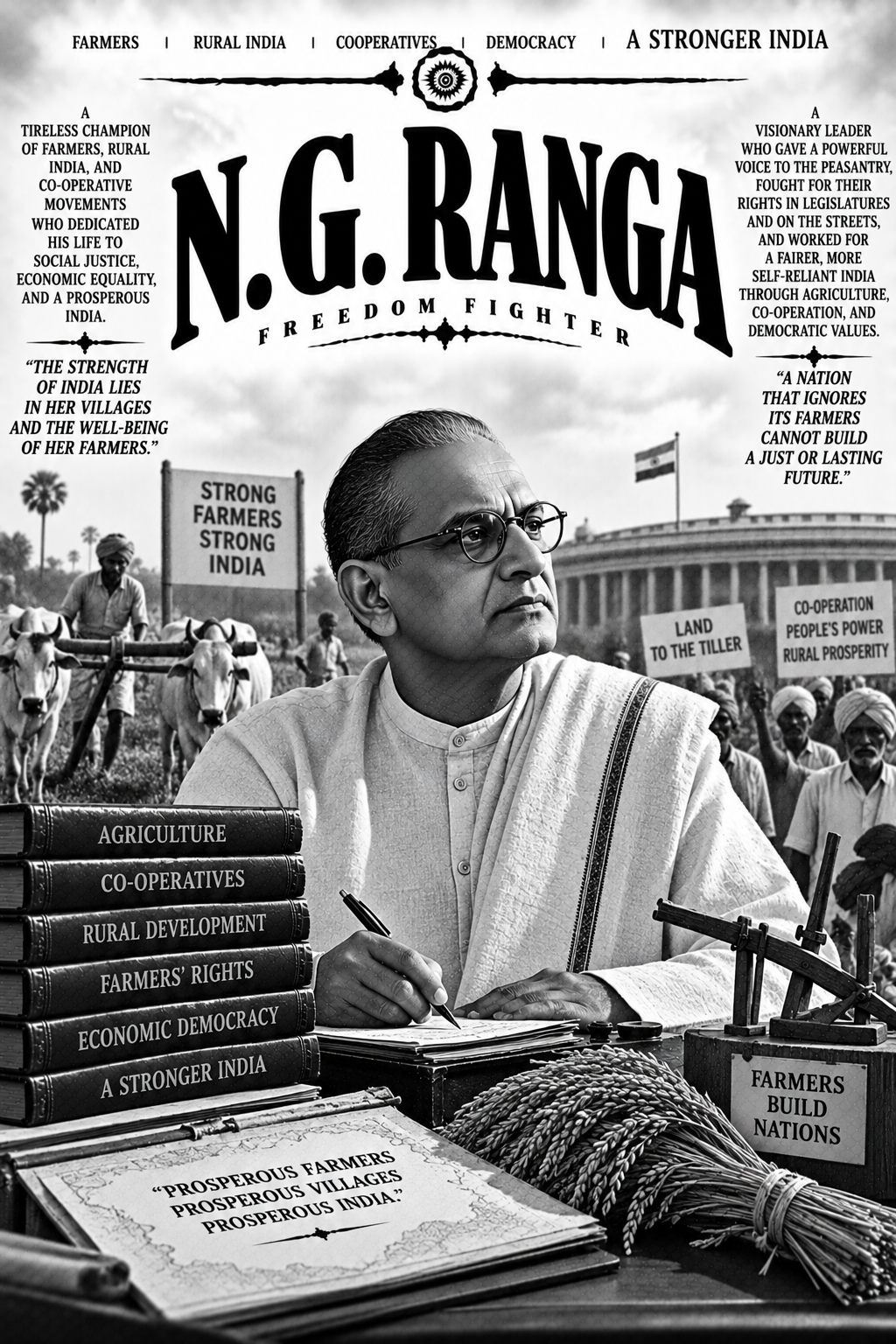
N. G. RANGA
Original price was: ₹199.00.₹9.00Current price is: ₹9.00.
He was an Oxford-trained political economist who could have commanded imperial secretariats or corporate boardrooms, yet he chose to plow the black soils of Nidubrolu in coarse hand-spun khadi. He was the frontline satyagrahi who defied British batons in colonial prisons, yet possessed the intellectual courage to challenge Mahatma Gandhi’s doctrines of landlord trusteeship, insisting that true freedom was impossible without land to the tiller.
Known to a grateful nation as the “Father of the Indian Peasant Movement,” Acharya N. G. Ranga (1900–1995) spent his life rewriting the rules of Indian politics. In 1928, he founded the Indian Peasant Institute in his native village, transforming tenant farmers and agricultural laborers into self-reliant, barefoot leaders. During the crushing depths of the Great Depression, his data-driven Resettlement Agitations forced the mighty British Raj into retreat across the deltas of Andhra. By 1936, alongside Swami Sahajanand Saraswati, he co-founded the All-India Kisan Sabha, framing the historic Kisan Manifesto that mobilized millions of cultivators into an unstoppable national vanguard.
Yet, Ranga’s greatest battle awaited him in independent India. When post-colonial leaders sought to enforce Soviet-style joint cooperative farming, Ranga refused to let the Indian farmer become a state serf. In an act of unparalleled political courage, he walked away from high ruling-party offices, co-founded the Swatantra Party with Rajaji, and mounted a legendary parliamentary filibuster to defend the property rights of the self-employed peasant family.
Across six historic decades in Parliament—earning a place in the *Guinness Book of World Records* as one of the world’s longest-serving democratic lawmakers—he remained the incorruptible “Peasant Tribune,” pioneering minimum support prices, agricultural credit reforms, and legal protections for handloom weavers.
Spanning the dusty canals of coastal Andhra, the scholarly halls of Oxford, British prison barracks, and the supreme chambers of Parliament, this definitive biography captures the immortal saga of a titan who gave the Indian cultivator an organized voice, a green banner, and an unshakeable place in the soul of the republic. It is the epic story of an intellectual of the soil who proved that the hands that hold the plough are the true masters of a free nation.
Product Details
| Publication Date | September 16, 2026 |
| Last Updated | September 16, 2026 |
| Print Length | 104 pages |
| Language | English |
| Format | PDF eBook |
| Availability | Instant Download |
| Publisher | Vancriskhom Publishers |
| Compatible Devices | PC, Tablet, Mobile |
He was an Oxford-trained political economist who could have commanded imperial secretariats or corporate boardrooms, yet he chose to plow the black soils of Nidubrolu in coarse hand-spun khadi. He was the frontline satyagrahi who defied British batons in colonial prisons, yet possessed the intellectual courage to challenge Mahatma Gandhi’s doctrines of landlord trusteeship, insisting that true freedom was impossible without land to the tiller.
Known to a grateful nation as the “Father of the Indian Peasant Movement,” Acharya N. G. Ranga (1900–1995) spent his life rewriting the rules of Indian politics. In 1928, he founded the Indian Peasant Institute in his native village, transforming tenant farmers and agricultural laborers into self-reliant, barefoot leaders. During the crushing depths of the Great Depression, his data-driven Resettlement Agitations forced the mighty British Raj into retreat across the deltas of Andhra. By 1936, alongside Swami Sahajanand Saraswati, he co-founded the All-India Kisan Sabha, framing the historic Kisan Manifesto that mobilized millions of cultivators into an unstoppable national vanguard.
Yet, Ranga’s greatest battle awaited him in independent India. When post-colonial leaders sought to enforce Soviet-style joint cooperative farming, Ranga refused to let the Indian farmer become a state serf. In an act of unparalleled political courage, he walked away from high ruling-party offices, co-founded the Swatantra Party with Rajaji, and mounted a legendary parliamentary filibuster to defend the property rights of the self-employed peasant family.
Across six historic decades in Parliament—earning a place in the *Guinness Book of World Records* as one of the world’s longest-serving democratic lawmakers—he remained the incorruptible “Peasant Tribune,” pioneering minimum support prices, agricultural credit reforms, and legal protections for handloom weavers.
Spanning the dusty canals of coastal Andhra, the scholarly halls of Oxford, British prison barracks, and the supreme chambers of Parliament, this definitive biography captures the immortal saga of a titan who gave the Indian cultivator an organized voice, a green banner, and an unshakeable place in the soul of the republic. It is the epic story of an intellectual of the soil who proved that the hands that hold the plough are the true masters of a free nation.
Only logged in customers who have purchased this product may leave a review.
General Enquiries
There are no enquiries yet.
Reviews
There are no reviews yet.