
RAJKUMARI AMRIT KAUR
September 8, 2026
BASANTI DEVI
September 8, 2026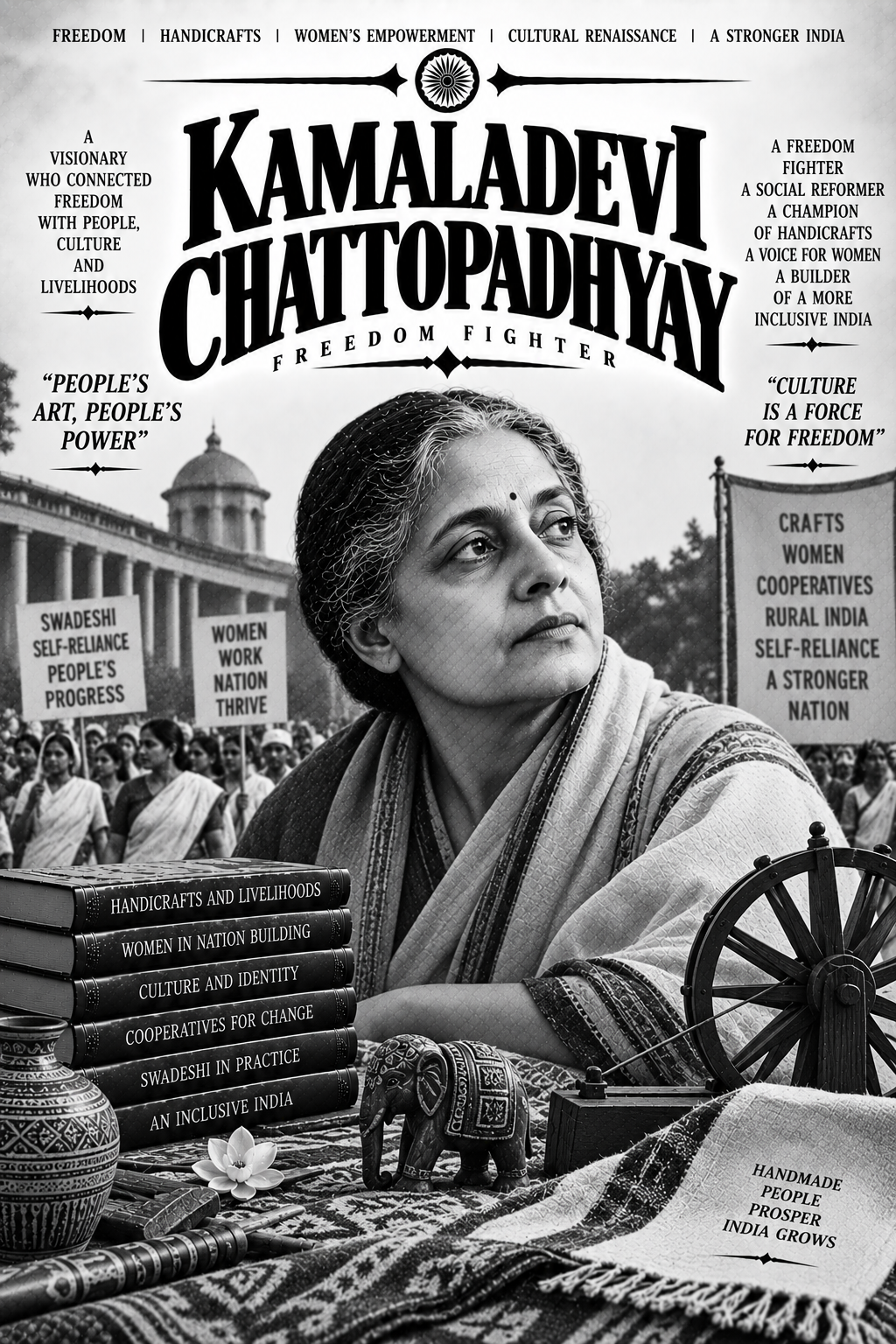
KAMALADEVI CHATTOPADHYAY
Original price was: ₹199.00.₹9.00Current price is: ₹9.00.
When midnight struck on August 15, 1947, and the British Union Jack descended across the subcontinent, millions celebrated the triumph of national liberation. Yet for Kamaladevi Chattopadhyay, the unfurling of the tricolor over the Red Fort in New Delhi was neither the conclusion of her journey nor an excuse for triumphal complacency. She understood with uncompromising clarity what many in the new ruling elite chose to overlook: that political independence (Swaraj) without radical social equality, cultural sovereignty, and decentralized economic autonomy was a hollow victory. A nation that simply swapped white colonial rulers for brown bureaucratic administrators, while leaving its women subjugated, its working classes exploited, its ancient crafts forgotten, and its artistic soul colonized, had not achieved true liberation—it had merely inherited an empire.
In the collective memory of modern India, Kamaladevi stands as a towering, singular force. She was a revolutionary who refused comfortable cabinet ministries and diplomatic ambassadorial postings, preferring the dust of refugee colonies, the heat of rural handloom sheds, and the rebellious platforms of non-conformist thought. Over a lifetime spanning more than eight decades (1903–1988), she was the fearless young widow who defied caste and patriarchal decrees, the vanguard leader who forced Mahatma Gandhi to open the Salt Satyagraha frontlines to women, the socialist organizer who confronted colonial police batons and prison cells, the pioneer who built the cooperative city of Faridabad, and the visionary who saved India’s living artistic traditions from extinction. Her life was an unyielding manifesto declaring that freedom is not an inert piece of cloth raised on a pole, but a living, daily practice of human dignity, creative labor, and social justice.
The Radical Roots: Shattering Feudal and Imperial Shorter Paths
Born on April 3, 1903, in the coastal town of Mangalore, Kamaladevi Dhareshwar’s character was forged in the fires of personal crisis and principled rebellion. Reared in the Chitrapur Saraswat Brahmin community, her early life was marked by sharp encounters with institutional injustice:
The Injustice of the Law: Following the sudden, intestate death of her father Ananthaya Dhareshwar, the archaic provisions of Hindu succession laws disinherited her mother Girijabai and her daughters overnight, handing their family wealth to distant male relatives. This early trauma instilled in Kamaladevi an abiding hatred for the patriarchal legal structures that reduced women to domestic dependents.
Defying the Living Death of Widowhood: Married off at fourteen according to child-marriage customs, she became a widow at fifteen when her young husband died. Orthodox tradition demanded that she submit to tonsure, cast off colored clothing, don the drab white shroud of mourning, and retreat into permanent domestic invisibility. Supported by her mother, Kamaladevi flatly refused. She kept her hair, wore her regular saris, and marched back into the classrooms of St. Ann’s Convent in Mangalore with her head held high, shattering the taboo through absolute defiance.
The Revolutionary Alliance: In 1919, she shattered social boundaries again by marrying the poet, playwright, and polymath Harindranath Chattopadhyay. It was an alliance that defied every orthodoxy: an inter-caste, inter-regional remarriage of an upper-caste widow. Together, they took modern theater onto the commercial stage, with Kamaladevi becoming the first educated Indian woman to perform openly in public drama, breaking the ancient social stigma that equated female performance with moral degradation.
The First Woman to Contest Elections (1926): In 1926, she made political history by contesting the South Kanara seat for the Madras Legislative Council. Although narrowly defeated by a conservative opponent by barely fifty-one votes, her candidacy was an electoral earthquake, establishing the right of Indian women to challenge male political dominance at the ballot box.
The Vanguard of Direct Action: The Salt Satyagraha of 1930
Kamaladevi’s historic intervention in the freedom movement was her uncompromising demand that women must not be relegated to the sidelines of anti-colonial resistance. When Mahatma Gandhi formulated the 1930 Salt Satyagraha and initially excluded women from the front line of marchers to Dandi—intending to reserve them for supportive roles like spinning and picketing—Kamaladevi tracked the Mahatma down at Jambusar in Gujarat.
She confronted Gandhi directly, insisting that freedom was indivisible. She argued that the salt tax was an assault on the household, the kitchen, and the daily sustenance of the poor—realms stewarded by women. She told him that women demanded the right to face colonial lathis, police bullets, and prison cells on terms of absolute equality with men. Moved by her moral force, Gandhi reversed his decision, issuing an open call that mobilized hundreds of thousands of Indian women to shatter the colonial salt monopoly.
In April 1930, Kamaladevi took command of the battle on the beaches of Bombay:
She led thousands to Chowpatty Beach, boiling seawater on portable stoves to manufacture illegal, contraband salt under the gaze of armed colonial police.
She scaled makeshift platforms to auction the contraband salt to cheering crowds, turning civil disobedience into an open-air public festival of defiance.
In acts of sheer theatrical audacity, she raided the high-security corridors of the Bombay High Court, walking into active courtrooms to offer illegal salt to British and Indian judges, before storming the trading floor of the Bombay Stock Exchange on Dalal Street, shutting down commercial operations as brokers scrambled to buy the “salt of freedom.”
During the multi-wave assaults on the heavily guarded Wadala Salt Depot, she stood at the head of mass volunteer brigades, absorbing police lathi charges and facing mounted police without retreating, proving that non-violent moral courage could dismantle armed imperial power.
The Carceral Furnace: The Prisoner Who Refused Subjugation
Her direct defiance resulted in multiple, brutal prison terms across the 1930s and 1940s, interned in Arthur Road, Vellore Central Jail, Belgaum, and other carceral installations of the Raj:
Rather than seeking relief, she weaponized her imprisonment, turning the female barracks into an academy of revolution. She organized literacy and arithmetic classes for illiterate peasant women, conducted daily spinning circles on the charkha, and led morning choirs singing anti-colonial anthems behind iron gates.
When colonial wardens starved, mistreated, and physically assaulted ordinary, non-political convict women, Kamaladevi launched hunger strikes, refusing food until prison authorities signed written guarantees ensuring sanitary living conditions, clean drinking water, and infant care for all incarcerated mothers.
During the Quit India revolt of August 1942, operating as an underground leader of the radical Congress Socialist Party (CSP) alongside Jayaprakash Narayan and Ram Manohar Lohia, she evaded colonial intelligence across provinces, coordinating strikes and clandestine communications before being captured and thrown into indefinite solitary detention under the draconian Defence of India Rules.
The Constructive Counter-Vision: Faridabad and the Cooperative Miracle
When independence arrived alongside the tragedy of Partition in 1947, Kamaladevi refused to celebrate while millions suffered. Confronting the sea of traumatized, destitute refugees dumped into squalid tent cities around Delhi, she rejected the state’s paternalistic dole system as an assault on the human spirit.
Founding the Indian Cooperative Union (ICU) in 1948, she launched one of the greatest self-help rehabilitation projects in post-colonial history:
The Construction of Faridabad: On a desolate, rocky expanse twenty-five kilometers south of Delhi, she mobilized thirty thousand Pashtun and Punjabi refugees to build their own model industrial and residential township from the earth up.
Bypassing the Exploiters: Refusing to hire private contractors or public works cartels, she trained the refugees into self-governing cooperative units. Former clerks, traders, and farmers learned brick-making, masonry, road construction, carpentry, and electrical engineering, building schools, houses, and factories with their own hands.
Economic Autonomy for Women: She organized displaced women into artisan cooperatives, reviving their ancestral traditions of Phulkari embroidery, providing raw materials, and guaranteeing fair, immediate wages.
The Central Cottage Industries Emporium (CCIE): To ensure these cooperatives survived against commercial cartels, she founded the CCIE in New Delhi in 1952, creating a direct marketing link between rural artisans and urban consumers, eliminating predatory middlemen, and ensuring that economic profits remained in the hands of the working makers.
Saving the Civilizational Soul: The Renaissance of Indian Crafts
Kamaladevi’s greatest structural legacy to the Indian Republic was her defense of the country’s ancestral artisans against the onslaught of unchecked, centralized industrialization. Serving as the foundational Chairman of the All India Handicrafts Board (AIHB) for fifteen years (1952–1967), she undertook grueling field expeditions across rural, tribal, and forested belts, mapping and rescuing traditions on the verge of extinction.
Her institutional contributions built the cultural architecture of modern India:
Reviving Ancient Legacies: She tracked down the last surviving master practitioners of hand-painted Kalamkari in Srikalahasti, rescued the ancient lost-wax bell-metal casting (Dhokra) of Bastar, restored classical Chola Panchaloha bronzes in Swamimalai, and institutionalized the preservation of regional textile traditions, including Bandhani, Patola, Chanderi, and Kantha.
The National Awards for Master Craftspersons (1965): She dismantled the feudal and caste prejudice that treated manual artisans as inferior laborers. By bringing village weavers, potters, and sculptors to the presidential palace to be formally honored by the President of India alongside statesmen and scientists, she elevated the artisan to the status of a revered national treasure.
The National Crafts Museum: She built the Crafts Museum in New Delhi not as a clinical gallery of dead objects behind glass, but as a living rural village complex where master craftspeople in residence lived, worked, demonstrated techniques, and sold directly to the public.
Autonomous Cultural Guardians: She founded the Crafts Council of India (CCI) in 1964 and co-founded the World Crafts Council (WCC), ensuring an international and non-governmental defense of artisan intellectual property rights.
The Living Stage: As a foundational architect of the Sangeet Natak Akademi and founder of the National School of Drama (NSD) in 1959, she rescued ancient temple theaters like Koodiyattam from oblivion and created an academy where modern dramaturgy was integrated with the classical aesthetics of the Natya Shastra and regional folk performance.
The Eternal Refusal: An Incorruptible Conscience
What made Kamaladevi Chattopadhyay truly immortal was her total incorruptibility. When high executive power was distributed in post-independence New Delhi, she deliberately walked away from ministerial portfolios, governorships, and ambassadorial honors. She refused to become an ornament of the state, choosing instead to remain an autonomous, critical voice of civil society.
When the Indian Emergency was imposed in 1975, suspending fundamental freedoms, jailing political dissidents, and silencing the press, Kamaladevi stood up with unbending courage. In her seventies, she publicly denounced the authoritarian suspension of democracy, resigning from government committees and openly supporting underground resistance leaders, demonstrating that she feared indigenous dictators just as little as she had feared British viceroys.
The True Meaning of Swaraj
When Kamaladevi Chattopadhyay passed away on October 29, 1988, at the age of eighty-five, she left behind an India fundamentally enriched by her fierce, generous spirit. She had received the highest honors the world could bestow—the Ramon Magsaysay Award for Community Leadership (1966), the Sangeet Natak Akademi Fellowship (1974), the Padma Bhushan (1955), and the Padma Vibhushan (1987). Yet her true monument is woven into the daily texture of Indian life.
To remember Kamaladevi Chattopadhyay is to remember that freedom is not an inheritance to be hoarded, but a continuous battle to be waged. It is seen in every independent woman who refuses domestic subjugation; every rural weaver who draws dignity, bread, and beauty from a wooden handloom; every actor who steps onto a stage to challenge power; and every citizen who refuses to let patriotism be reduced to empty flags and hollow anthems. She was the indomitable rebel who gave her life to ensure that the freedom of India belonged, forever and unconditionally, to the sovereign, working hands of its people.
Product Details
| Publication Date | September 8, 2026 |
| Last Updated | September 8, 2026 |
| Print Length | 102 pages |
| Language | English |
| Format | PDF eBook |
| Availability | Instant Download |
| Publisher | Vancriskhom Publishers |
| Compatible Devices | PC, Tablet, Mobile |
When midnight struck on August 15, 1947, and the British Union Jack descended across the subcontinent, millions celebrated the triumph of national liberation. Yet for Kamaladevi Chattopadhyay, the unfurling of the tricolor over the Red Fort in New Delhi was neither the conclusion of her journey nor an excuse for triumphal complacency. She understood with uncompromising clarity what many in the new ruling elite chose to overlook: that political independence (Swaraj) without radical social equality, cultural sovereignty, and decentralized economic autonomy was a hollow victory. A nation that simply swapped white colonial rulers for brown bureaucratic administrators, while leaving its women subjugated, its working classes exploited, its ancient crafts forgotten, and its artistic soul colonized, had not achieved true liberation—it had merely inherited an empire.
In the collective memory of modern India, Kamaladevi stands as a towering, singular force. She was a revolutionary who refused comfortable cabinet ministries and diplomatic ambassadorial postings, preferring the dust of refugee colonies, the heat of rural handloom sheds, and the rebellious platforms of non-conformist thought. Over a lifetime spanning more than eight decades (1903–1988), she was the fearless young widow who defied caste and patriarchal decrees, the vanguard leader who forced Mahatma Gandhi to open the Salt Satyagraha frontlines to women, the socialist organizer who confronted colonial police batons and prison cells, the pioneer who built the cooperative city of Faridabad, and the visionary who saved India’s living artistic traditions from extinction. Her life was an unyielding manifesto declaring that freedom is not an inert piece of cloth raised on a pole, but a living, daily practice of human dignity, creative labor, and social justice.
The Radical Roots: Shattering Feudal and Imperial Shorter Paths
Born on April 3, 1903, in the coastal town of Mangalore, Kamaladevi Dhareshwar’s character was forged in the fires of personal crisis and principled rebellion. Reared in the Chitrapur Saraswat Brahmin community, her early life was marked by sharp encounters with institutional injustice:
The Injustice of the Law: Following the sudden, intestate death of her father Ananthaya Dhareshwar, the archaic provisions of Hindu succession laws disinherited her mother Girijabai and her daughters overnight, handing their family wealth to distant male relatives. This early trauma instilled in Kamaladevi an abiding hatred for the patriarchal legal structures that reduced women to domestic dependents.
Defying the Living Death of Widowhood: Married off at fourteen according to child-marriage customs, she became a widow at fifteen when her young husband died. Orthodox tradition demanded that she submit to tonsure, cast off colored clothing, don the drab white shroud of mourning, and retreat into permanent domestic invisibility. Supported by her mother, Kamaladevi flatly refused. She kept her hair, wore her regular saris, and marched back into the classrooms of St. Ann’s Convent in Mangalore with her head held high, shattering the taboo through absolute defiance.
The Revolutionary Alliance: In 1919, she shattered social boundaries again by marrying the poet, playwright, and polymath Harindranath Chattopadhyay. It was an alliance that defied every orthodoxy: an inter-caste, inter-regional remarriage of an upper-caste widow. Together, they took modern theater onto the commercial stage, with Kamaladevi becoming the first educated Indian woman to perform openly in public drama, breaking the ancient social stigma that equated female performance with moral degradation.
The First Woman to Contest Elections (1926): In 1926, she made political history by contesting the South Kanara seat for the Madras Legislative Council. Although narrowly defeated by a conservative opponent by barely fifty-one votes, her candidacy was an electoral earthquake, establishing the right of Indian women to challenge male political dominance at the ballot box.
The Vanguard of Direct Action: The Salt Satyagraha of 1930
Kamaladevi’s historic intervention in the freedom movement was her uncompromising demand that women must not be relegated to the sidelines of anti-colonial resistance. When Mahatma Gandhi formulated the 1930 Salt Satyagraha and initially excluded women from the front line of marchers to Dandi—intending to reserve them for supportive roles like spinning and picketing—Kamaladevi tracked the Mahatma down at Jambusar in Gujarat.
She confronted Gandhi directly, insisting that freedom was indivisible. She argued that the salt tax was an assault on the household, the kitchen, and the daily sustenance of the poor—realms stewarded by women. She told him that women demanded the right to face colonial lathis, police bullets, and prison cells on terms of absolute equality with men. Moved by her moral force, Gandhi reversed his decision, issuing an open call that mobilized hundreds of thousands of Indian women to shatter the colonial salt monopoly.
In April 1930, Kamaladevi took command of the battle on the beaches of Bombay:
She led thousands to Chowpatty Beach, boiling seawater on portable stoves to manufacture illegal, contraband salt under the gaze of armed colonial police.
She scaled makeshift platforms to auction the contraband salt to cheering crowds, turning civil disobedience into an open-air public festival of defiance.
In acts of sheer theatrical audacity, she raided the high-security corridors of the Bombay High Court, walking into active courtrooms to offer illegal salt to British and Indian judges, before storming the trading floor of the Bombay Stock Exchange on Dalal Street, shutting down commercial operations as brokers scrambled to buy the “salt of freedom.”
During the multi-wave assaults on the heavily guarded Wadala Salt Depot, she stood at the head of mass volunteer brigades, absorbing police lathi charges and facing mounted police without retreating, proving that non-violent moral courage could dismantle armed imperial power.
The Carceral Furnace: The Prisoner Who Refused Subjugation
Her direct defiance resulted in multiple, brutal prison terms across the 1930s and 1940s, interned in Arthur Road, Vellore Central Jail, Belgaum, and other carceral installations of the Raj:
Rather than seeking relief, she weaponized her imprisonment, turning the female barracks into an academy of revolution. She organized literacy and arithmetic classes for illiterate peasant women, conducted daily spinning circles on the charkha, and led morning choirs singing anti-colonial anthems behind iron gates.
When colonial wardens starved, mistreated, and physically assaulted ordinary, non-political convict women, Kamaladevi launched hunger strikes, refusing food until prison authorities signed written guarantees ensuring sanitary living conditions, clean drinking water, and infant care for all incarcerated mothers.
During the Quit India revolt of August 1942, operating as an underground leader of the radical Congress Socialist Party (CSP) alongside Jayaprakash Narayan and Ram Manohar Lohia, she evaded colonial intelligence across provinces, coordinating strikes and clandestine communications before being captured and thrown into indefinite solitary detention under the draconian Defence of India Rules.
The Constructive Counter-Vision: Faridabad and the Cooperative Miracle
When independence arrived alongside the tragedy of Partition in 1947, Kamaladevi refused to celebrate while millions suffered. Confronting the sea of traumatized, destitute refugees dumped into squalid tent cities around Delhi, she rejected the state’s paternalistic dole system as an assault on the human spirit.
Founding the Indian Cooperative Union (ICU) in 1948, she launched one of the greatest self-help rehabilitation projects in post-colonial history:
The Construction of Faridabad: On a desolate, rocky expanse twenty-five kilometers south of Delhi, she mobilized thirty thousand Pashtun and Punjabi refugees to build their own model industrial and residential township from the earth up.
Bypassing the Exploiters: Refusing to hire private contractors or public works cartels, she trained the refugees into self-governing cooperative units. Former clerks, traders, and farmers learned brick-making, masonry, road construction, carpentry, and electrical engineering, building schools, houses, and factories with their own hands.
Economic Autonomy for Women: She organized displaced women into artisan cooperatives, reviving their ancestral traditions of Phulkari embroidery, providing raw materials, and guaranteeing fair, immediate wages.
The Central Cottage Industries Emporium (CCIE): To ensure these cooperatives survived against commercial cartels, she founded the CCIE in New Delhi in 1952, creating a direct marketing link between rural artisans and urban consumers, eliminating predatory middlemen, and ensuring that economic profits remained in the hands of the working makers.
Saving the Civilizational Soul: The Renaissance of Indian Crafts
Kamaladevi’s greatest structural legacy to the Indian Republic was her defense of the country’s ancestral artisans against the onslaught of unchecked, centralized industrialization. Serving as the foundational Chairman of the All India Handicrafts Board (AIHB) for fifteen years (1952–1967), she undertook grueling field expeditions across rural, tribal, and forested belts, mapping and rescuing traditions on the verge of extinction.
Her institutional contributions built the cultural architecture of modern India:
Reviving Ancient Legacies: She tracked down the last surviving master practitioners of hand-painted Kalamkari in Srikalahasti, rescued the ancient lost-wax bell-metal casting (Dhokra) of Bastar, restored classical Chola Panchaloha bronzes in Swamimalai, and institutionalized the preservation of regional textile traditions, including Bandhani, Patola, Chanderi, and Kantha.
The National Awards for Master Craftspersons (1965): She dismantled the feudal and caste prejudice that treated manual artisans as inferior laborers. By bringing village weavers, potters, and sculptors to the presidential palace to be formally honored by the President of India alongside statesmen and scientists, she elevated the artisan to the status of a revered national treasure.
The National Crafts Museum: She built the Crafts Museum in New Delhi not as a clinical gallery of dead objects behind glass, but as a living rural village complex where master craftspeople in residence lived, worked, demonstrated techniques, and sold directly to the public.
Autonomous Cultural Guardians: She founded the Crafts Council of India (CCI) in 1964 and co-founded the World Crafts Council (WCC), ensuring an international and non-governmental defense of artisan intellectual property rights.
The Living Stage: As a foundational architect of the Sangeet Natak Akademi and founder of the National School of Drama (NSD) in 1959, she rescued ancient temple theaters like Koodiyattam from oblivion and created an academy where modern dramaturgy was integrated with the classical aesthetics of the Natya Shastra and regional folk performance.
The Eternal Refusal: An Incorruptible Conscience
What made Kamaladevi Chattopadhyay truly immortal was her total incorruptibility. When high executive power was distributed in post-independence New Delhi, she deliberately walked away from ministerial portfolios, governorships, and ambassadorial honors. She refused to become an ornament of the state, choosing instead to remain an autonomous, critical voice of civil society.
When the Indian Emergency was imposed in 1975, suspending fundamental freedoms, jailing political dissidents, and silencing the press, Kamaladevi stood up with unbending courage. In her seventies, she publicly denounced the authoritarian suspension of democracy, resigning from government committees and openly supporting underground resistance leaders, demonstrating that she feared indigenous dictators just as little as she had feared British viceroys.
The True Meaning of Swaraj
When Kamaladevi Chattopadhyay passed away on October 29, 1988, at the age of eighty-five, she left behind an India fundamentally enriched by her fierce, generous spirit. She had received the highest honors the world could bestow—the Ramon Magsaysay Award for Community Leadership (1966), the Sangeet Natak Akademi Fellowship (1974), the Padma Bhushan (1955), and the Padma Vibhushan (1987). Yet her true monument is woven into the daily texture of Indian life.
To remember Kamaladevi Chattopadhyay is to remember that freedom is not an inheritance to be hoarded, but a continuous battle to be waged. It is seen in every independent woman who refuses domestic subjugation; every rural weaver who draws dignity, bread, and beauty from a wooden handloom; every actor who steps onto a stage to challenge power; and every citizen who refuses to let patriotism be reduced to empty flags and hollow anthems. She was the indomitable rebel who gave her life to ensure that the freedom of India belonged, forever and unconditionally, to the sovereign, working hands of its people.
Only logged in customers who have purchased this product may leave a review.
General Enquiries
There are no enquiries yet.
Related products
-
The MindVault Files: Book 9: The Man Who Didn’t Breathe
Original price was: ₹250.00.₹129.00Current price is: ₹129.00. EAN: 2000000001623

Reviews
There are no reviews yet.