
KASINADHUNI NAGESWARA RAO
September 7, 2026
THE WHY MERGED
September 7, 2026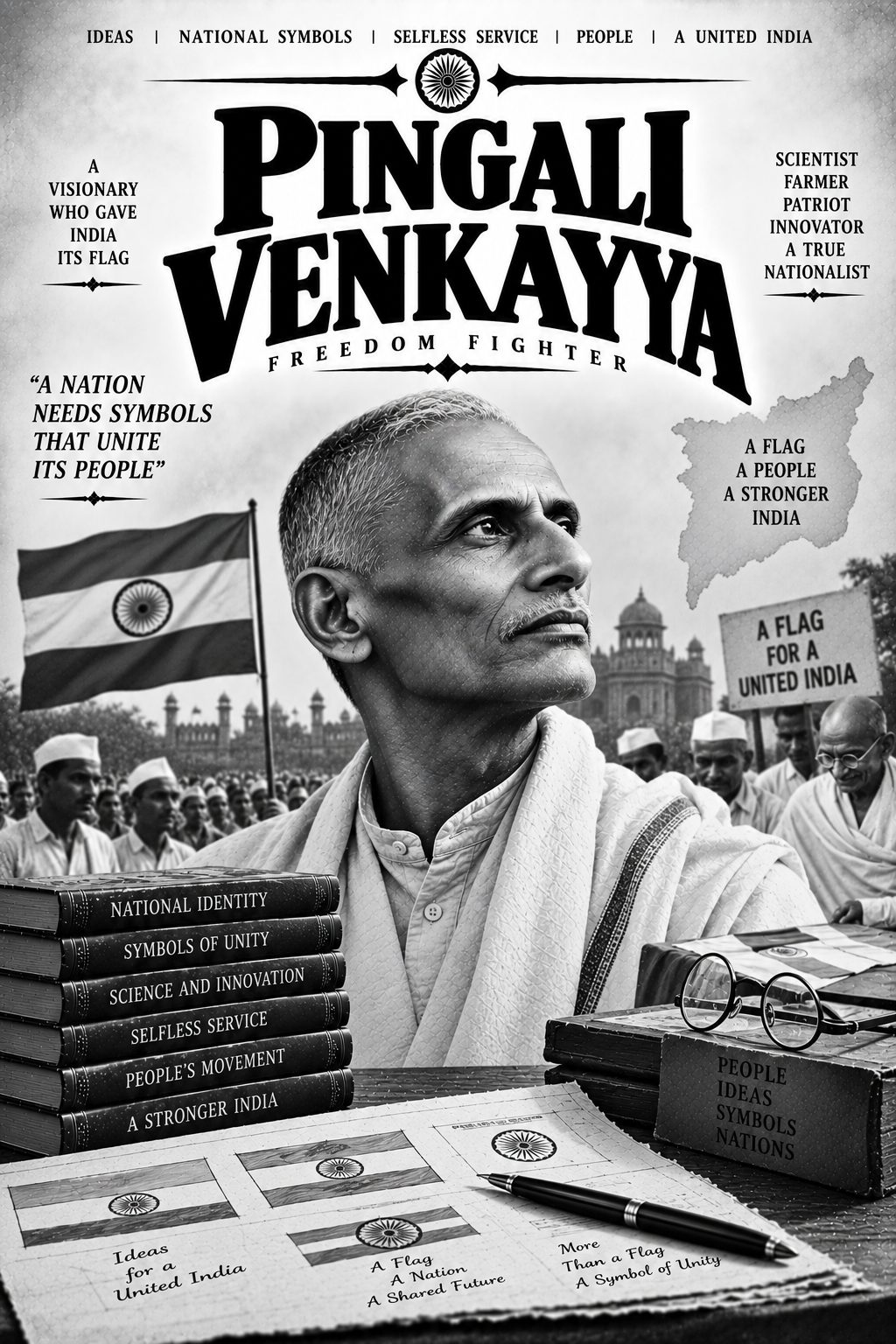
PINGALI VENKAYYA
Original price was: ₹199.00.₹9.00Current price is: ₹9.00.
Every morning across the Indian Republic, over a billion hearts beat as one as the saffron, white, and emerald green standard rises into the sky. It flies proudly atop the ramparts of the Red Fort, cuts through oceanic swells aboard naval destroyers, flutters in the sub-zero winds of Himalayan border outposts, and greets the dawn in millions of rural schoolyards. We know its sacred geometry, its twenty-four-spoked wheel of cosmic Dharma, and the ideals of courage, truth, and prosperity woven into its fabric. Yet, behind this supreme emblem of sovereign India lived a quiet, selfless genius whose extraordinary life reads like an epic of adventure, science, and boundless devotion—a man who gave an entire nation its visual soul, yet asked for nothing in return. That man was Pingali Venkayya.
Born in the rural heart of coastal Andhra in the quiet village of Bhatlapenumarru, Venkayya was a visionary polymath whose life defied every colonial constraint. At just nineteen, driven by a fierce desire to master military discipline and field strategy, he enlisted in the British Indian Army and crossed the oceans to serve in the Second Boer War in South Africa. Amid the thunder of artillery on the African veld, his destiny was irrevocably altered. Standing beside imperial regiments that saluted their sovereign colors, Venkayya watched Indian soldiers bleed and labor under the Union Jack—the very emblem of their own domestic enslavement. In that searing moment of national humiliation, compounded by his fateful first encounters with a young Indian barrister named Mohandas Karamchand Gandhi, a sacred obsession took root in Venkayya’s soul: an ancient civilization of hundreds of millions could never break its chains without a flag of its own.
Returning to India, Venkayya embarked on a relentless fifteen-year crusade that transformed him into the father of Indian vexillology. He was a pioneer in every frontier he touched: an agronomist who hybridized long-staple cotton to liberate Deccan farmers from British monopolies as “Patti Venkayya”; a trained geologist who surveyed the rocky gorges of the Krishna River to unearth diamond and mica deposits as “Diamond Venkayya”; and a brilliant linguist fluent in Urdu and Japanese who lectured across the country as “Japan Venkayya.” Yet, through all his scientific breakthroughs, his heart remained tethered to a single quest. In 1916, he published his historic treatise, A National Flag for India, presenting dozens of indigenous flag designs and lobbying the national leadership from one Congress plenary to the next, earning the affectionate title of “Jhanda Venkayya.”
The turning point of his life—and the visual birth of a nation—arrived on the sunlit sands of the Krishna River during the historic Vijayawada AICC session of 1921. Summoned by Mahatma Gandhi into the halls of the Victoria Jubilee Museum, Venkayya sat down and, within three inspired hours, drafted the immortal tripartite standard that captured the conscience of the subcontinent. From the heroic martyrs of the 1923 Nagpur Flag Satyagraha who shielded the banner with their bare bodies, to the Salt Marchers of 1930 and the battle-hardened soldiers of Netaji’s Indian National Army, Venkayya’s tricolour was baptized in the fire of mass sacrifice. When independence finally dawned at midnight on August 15, 1947, and the Ashoka Chakra took its rightful place at the center of the white band, it was Venkayya’s foundational design that rose above a liberated motherland.
Yet the ultimate measure of Pingali Venkayya’s nobility lay in what followed. He sought neither political office, ministerial power, nor public acclaim. Living in dignified simplicity, he spent his twilight years surrounded by his books, rock specimens, and flag sketches, passing away in quiet austerity with his gaze resting upon the tricolour beside his bed—requesting only to be wrapped in the hand-spun khadi banner he had gifted to his people.
This definitive, fact-filled, and deeply moving biography brings to life the untold saga of India’s flag-maker: the soldier who learned the power of symbols on foreign battlefields, the polymath who mapped India’s soil and minerals, the satyagrahi who designed a revolution in three hours, and the unsung titan whose legacy flutters above every free Indian today. Step into an extraordinary journey of patriotism, sacrifice, and unyielding purpose—the immortal story of the quiet patriot who stitched the soul of India onto cloth for all eternity.
Product Details
| ISBN | 978-81-17558-28-7 |
| Publication Date | September 7, 2026 |
| Last Updated | October 3, 2026 |
| Print Length | 74 pages |
| Language | English |
| Format | PDF eBook |
| Availability | Instant Download |
| Publisher | Vancriskhom Publishers |
| Compatible Devices | PC, Tablet, Mobile |
Every morning across the Indian Republic, over a billion hearts beat as one as the saffron, white, and emerald green standard rises into the sky. It flies proudly atop the ramparts of the Red Fort, cuts through oceanic swells aboard naval destroyers, flutters in the sub-zero winds of Himalayan border outposts, and greets the dawn in millions of rural schoolyards. We know its sacred geometry, its twenty-four-spoked wheel of cosmic Dharma, and the ideals of courage, truth, and prosperity woven into its fabric. Yet, behind this supreme emblem of sovereign India lived a quiet, selfless genius whose extraordinary life reads like an epic of adventure, science, and boundless devotion—a man who gave an entire nation its visual soul, yet asked for nothing in return. That man was Pingali Venkayya.
Born in the rural heart of coastal Andhra in the quiet village of Bhatlapenumarru, Venkayya was a visionary polymath whose life defied every colonial constraint. At just nineteen, driven by a fierce desire to master military discipline and field strategy, he enlisted in the British Indian Army and crossed the oceans to serve in the Second Boer War in South Africa. Amid the thunder of artillery on the African veld, his destiny was irrevocably altered. Standing beside imperial regiments that saluted their sovereign colors, Venkayya watched Indian soldiers bleed and labor under the Union Jack—the very emblem of their own domestic enslavement. In that searing moment of national humiliation, compounded by his fateful first encounters with a young Indian barrister named Mohandas Karamchand Gandhi, a sacred obsession took root in Venkayya’s soul: an ancient civilization of hundreds of millions could never break its chains without a flag of its own.
Returning to India, Venkayya embarked on a relentless fifteen-year crusade that transformed him into the father of Indian vexillology. He was a pioneer in every frontier he touched: an agronomist who hybridized long-staple cotton to liberate Deccan farmers from British monopolies as “Patti Venkayya”; a trained geologist who surveyed the rocky gorges of the Krishna River to unearth diamond and mica deposits as “Diamond Venkayya”; and a brilliant linguist fluent in Urdu and Japanese who lectured across the country as “Japan Venkayya.” Yet, through all his scientific breakthroughs, his heart remained tethered to a single quest. In 1916, he published his historic treatise, A National Flag for India, presenting dozens of indigenous flag designs and lobbying the national leadership from one Congress plenary to the next, earning the affectionate title of “Jhanda Venkayya.”
The turning point of his life—and the visual birth of a nation—arrived on the sunlit sands of the Krishna River during the historic Vijayawada AICC session of 1921. Summoned by Mahatma Gandhi into the halls of the Victoria Jubilee Museum, Venkayya sat down and, within three inspired hours, drafted the immortal tripartite standard that captured the conscience of the subcontinent. From the heroic martyrs of the 1923 Nagpur Flag Satyagraha who shielded the banner with their bare bodies, to the Salt Marchers of 1930 and the battle-hardened soldiers of Netaji’s Indian National Army, Venkayya’s tricolour was baptized in the fire of mass sacrifice. When independence finally dawned at midnight on August 15, 1947, and the Ashoka Chakra took its rightful place at the center of the white band, it was Venkayya’s foundational design that rose above a liberated motherland.
Yet the ultimate measure of Pingali Venkayya’s nobility lay in what followed. He sought neither political office, ministerial power, nor public acclaim. Living in dignified simplicity, he spent his twilight years surrounded by his books, rock specimens, and flag sketches, passing away in quiet austerity with his gaze resting upon the tricolour beside his bed—requesting only to be wrapped in the hand-spun khadi banner he had gifted to his people.
This definitive, fact-filled, and deeply moving biography brings to life the untold saga of India’s flag-maker: the soldier who learned the power of symbols on foreign battlefields, the polymath who mapped India’s soil and minerals, the satyagrahi who designed a revolution in three hours, and the unsung titan whose legacy flutters above every free Indian today. Step into an extraordinary journey of patriotism, sacrifice, and unyielding purpose—the immortal story of the quiet patriot who stitched the soul of India onto cloth for all eternity.
Only logged in customers who have purchased this product may leave a review.
General Enquiries
There are no enquiries yet.
Reviews
There are no reviews yet.