
GADICHERLA HARISARVOTTAMA RAO
September 7, 2026
KASINADHUNI NAGESWARA RAO
September 7, 2026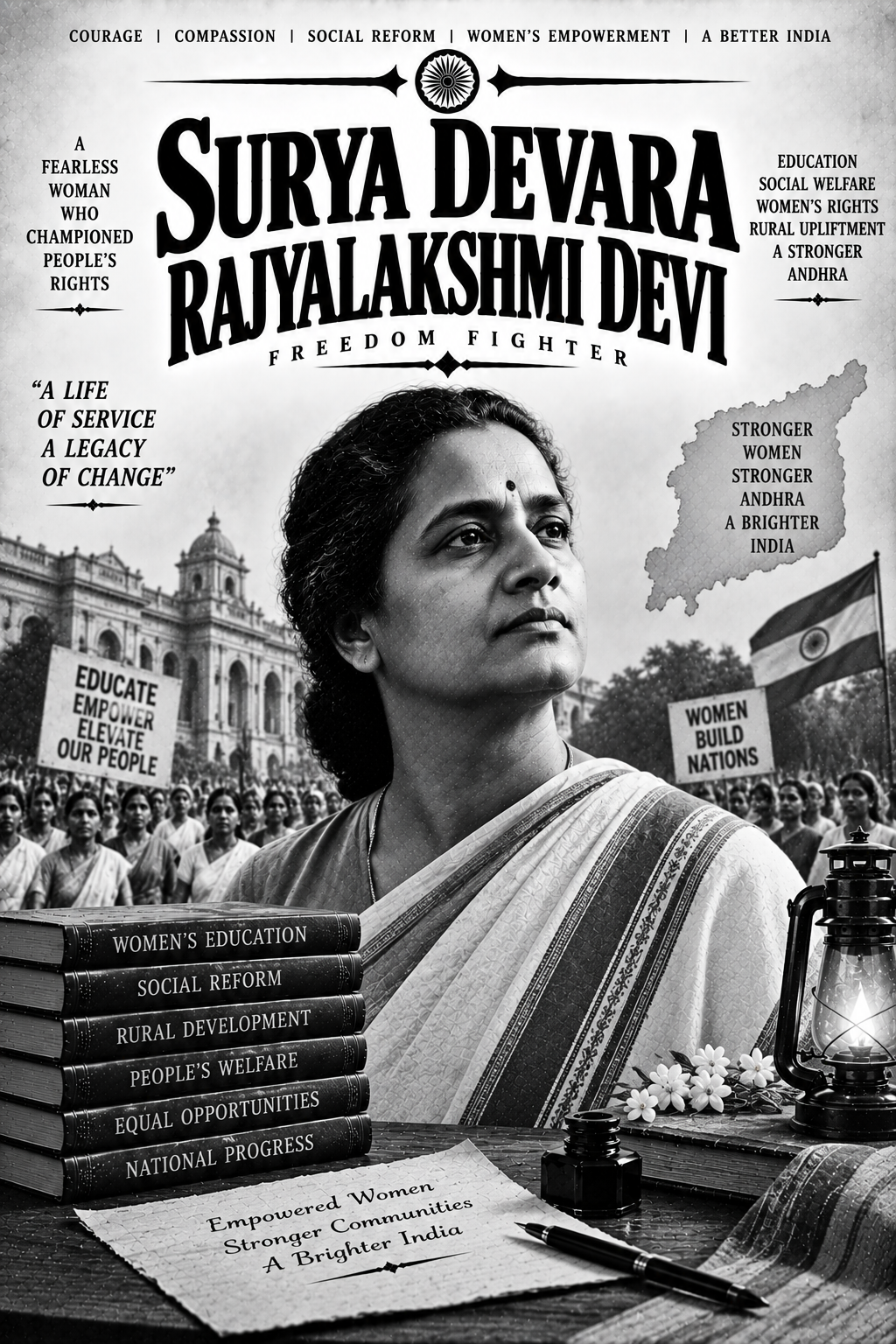
SURYA DEVARA RAJYALAKSHMI DEVI
Original price was: ₹199.00.₹9.00Current price is: ₹9.00.
When the history of India’s freedom struggle is written, the spotlight often falls on the grand assemblies, the charismatic male orators, and the high-stakes political negotiations in distant capitals. Yet, the true battle for the soul of the nation was fought across the dusty lanes of rural India—in the inner courtyards where women broke centuries of domestic confinement, took up the spinning wheel, and marched directly into the path of colonial police batons. Foremost among these indomitable daughters of the soil stood Suryadevara Rajyalakshmi Devi: an aristocratic rural matriarch from Guntur who renounced immense wealth, led an army of women into the fire of civil disobedience, faced imperial violence without retreating an inch, and proved that the moral courage of an awakened womanhood was more than a match for the armed might of the British Empire.
Born into the prosperous agrarian aristocracy of coastal Andhra, Rajyalakshmi Devi had a life of privilege, security, and domestic comfort laid out before her. She chose instead the path of thorns. In 1921, on the sands of the Krishna River at the historic Vijayawada Congress session, she answered Mahatma Gandhi’s clarion call with an act of radical renunciation that shook the conservative society of Andhra. In full public view, she cast her luxurious silks and foreign fabrics into roaring Swadeshi bonfires, gave away her gold heirlooms to the Tilak Swaraj Fund, and took a lifelong vow of coarse, hand-spun khadi. Transforming her ancestral home into an open, caste-free national sanctuary and logistical fortress for the freedom movement, she turned the humble wooden *charkha* into an engine of economic revolt.
When the Civil Disobedience Movement of 1930 erupted and the British colonial state launched a ruthless dragnet—arresting the entire male leadership across Andhra, including her own husband—the British expected the agitation to collapse. Instead, Rajyalakshmi Devi stepped into the breach. Operating as an underground “Dictator” of the resistance, she mobilized thousands of ordinary rural women, many carrying infants in their arms, and marched them to the coastal salt flats of the Bay of Bengal to break the imperial Salt Laws. She organized human barricades outside foreign cloth emporiums and government arrack depots, choking the revenues of the colonial state. When armed police charged peaceful picketing lines with heavy cane batons (*lathis*), Rajyalakshmi Devi stood as a physical shield for younger volunteers, taking the brutal blows upon her own body with serene, unwavering dignity.
Branded a dangerous rebel by the Crown, she was repeatedly convicted of sedition and hurled into the damp, overcrowded stone barracks of the Central Jail for Women at Vellore. Treated like a common criminal convict, subjected to inedible rations and punitive labor, her physical health was permanently broken, but her revolutionary spirit emerged untouched. Even behind iron bars, she organized literacy circles and prayer meetings, turning colonial cells into centers of patriotic solidarity.
Yet, her battle went far deeper than political independence. Rajyalakshmi Devi understood that a nation divided against itself could never be truly free. With the same fearlessness she directed against British magistrates, she took on entrenched social orthodoxy at home. She campaigned relentlessly against child marriage, personally arranged and protected widow remarriages despite threats of ritual excommunication, established rural adult literacy schools, and walked directly into segregated Dalit quarters to demand temple entry, clean drinking water, and the absolute eradication of untouchability. When freedom finally dawned on August 15, 1947, she sought neither power, political office, nor pensions. Having given her youth, her fortune, her health, and her family’s peace to the altar of the motherland, she quietly returned to grassroots service in the villages of Guntur, asking for nothing and leaving everything behind.
This gripping, fact-filled, and deeply stirring biography resurrects the extraordinary life of Suryadevara Rajyalakshmi Devi: the agrarian matriarch, the frontline commander of civil disobedience, the fearless prisoner of conscience, and the tireless reformer whose courage rewrote the history of Andhra. Turn these pages to discover the unforgettable saga of a forgotten titan—a woman of unbreakable resolve whose sacrifice broke the chains of an empire and whose legacy remains an immortal flame of liberty for generations to come.
Product Details
| ISBN | 978-81-17558-26-3 |
| Publication Date | September 7, 2026 |
| Last Updated | October 3, 2026 |
| Print Length | 72 pages |
| Language | English |
| Format | PDF eBook |
| Availability | Instant Download |
| Publisher | Vancriskhom Publishers |
| Compatible Devices | PC, Tablet, Mobile |
When the history of India’s freedom struggle is written, the spotlight often falls on the grand assemblies, the charismatic male orators, and the high-stakes political negotiations in distant capitals. Yet, the true battle for the soul of the nation was fought across the dusty lanes of rural India—in the inner courtyards where women broke centuries of domestic confinement, took up the spinning wheel, and marched directly into the path of colonial police batons. Foremost among these indomitable daughters of the soil stood Suryadevara Rajyalakshmi Devi: an aristocratic rural matriarch from Guntur who renounced immense wealth, led an army of women into the fire of civil disobedience, faced imperial violence without retreating an inch, and proved that the moral courage of an awakened womanhood was more than a match for the armed might of the British Empire.
Born into the prosperous agrarian aristocracy of coastal Andhra, Rajyalakshmi Devi had a life of privilege, security, and domestic comfort laid out before her. She chose instead the path of thorns. In 1921, on the sands of the Krishna River at the historic Vijayawada Congress session, she answered Mahatma Gandhi’s clarion call with an act of radical renunciation that shook the conservative society of Andhra. In full public view, she cast her luxurious silks and foreign fabrics into roaring Swadeshi bonfires, gave away her gold heirlooms to the Tilak Swaraj Fund, and took a lifelong vow of coarse, hand-spun khadi. Transforming her ancestral home into an open, caste-free national sanctuary and logistical fortress for the freedom movement, she turned the humble wooden *charkha* into an engine of economic revolt.
When the Civil Disobedience Movement of 1930 erupted and the British colonial state launched a ruthless dragnet—arresting the entire male leadership across Andhra, including her own husband—the British expected the agitation to collapse. Instead, Rajyalakshmi Devi stepped into the breach. Operating as an underground “Dictator” of the resistance, she mobilized thousands of ordinary rural women, many carrying infants in their arms, and marched them to the coastal salt flats of the Bay of Bengal to break the imperial Salt Laws. She organized human barricades outside foreign cloth emporiums and government arrack depots, choking the revenues of the colonial state. When armed police charged peaceful picketing lines with heavy cane batons (*lathis*), Rajyalakshmi Devi stood as a physical shield for younger volunteers, taking the brutal blows upon her own body with serene, unwavering dignity.
Branded a dangerous rebel by the Crown, she was repeatedly convicted of sedition and hurled into the damp, overcrowded stone barracks of the Central Jail for Women at Vellore. Treated like a common criminal convict, subjected to inedible rations and punitive labor, her physical health was permanently broken, but her revolutionary spirit emerged untouched. Even behind iron bars, she organized literacy circles and prayer meetings, turning colonial cells into centers of patriotic solidarity.
Yet, her battle went far deeper than political independence. Rajyalakshmi Devi understood that a nation divided against itself could never be truly free. With the same fearlessness she directed against British magistrates, she took on entrenched social orthodoxy at home. She campaigned relentlessly against child marriage, personally arranged and protected widow remarriages despite threats of ritual excommunication, established rural adult literacy schools, and walked directly into segregated Dalit quarters to demand temple entry, clean drinking water, and the absolute eradication of untouchability. When freedom finally dawned on August 15, 1947, she sought neither power, political office, nor pensions. Having given her youth, her fortune, her health, and her family’s peace to the altar of the motherland, she quietly returned to grassroots service in the villages of Guntur, asking for nothing and leaving everything behind.
This gripping, fact-filled, and deeply stirring biography resurrects the extraordinary life of Suryadevara Rajyalakshmi Devi: the agrarian matriarch, the frontline commander of civil disobedience, the fearless prisoner of conscience, and the tireless reformer whose courage rewrote the history of Andhra. Turn these pages to discover the unforgettable saga of a forgotten titan—a woman of unbreakable resolve whose sacrifice broke the chains of an empire and whose legacy remains an immortal flame of liberty for generations to come.
Only logged in customers who have purchased this product may leave a review.
General Enquiries
There are no enquiries yet.
Related products
-
Sorry!!! Wrong Shaadi!
Original price was: ₹250.00.₹129.00Current price is: ₹129.00. EAN: 2000000001371

Reviews
There are no reviews yet.